Overview
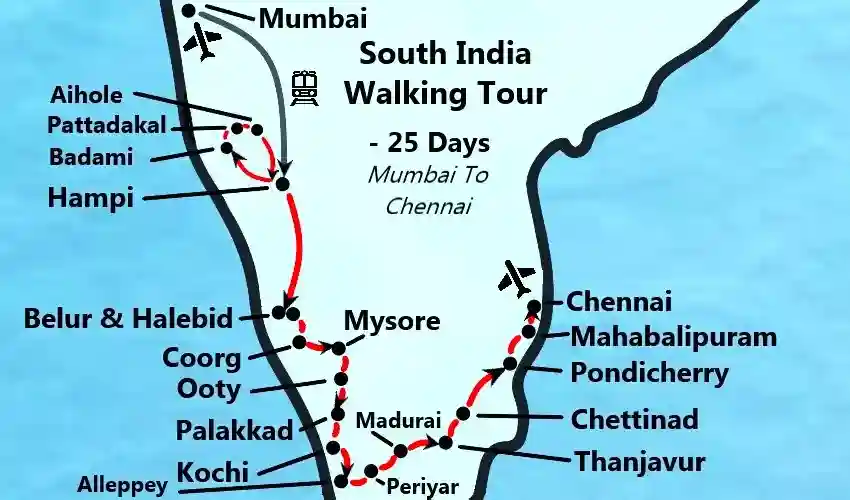
Most South India tours give you the highlights. This South India walking tour gives you the civilisations behind them. The Vijayanagara Empire at Hampi. The Chalukyas at Badami. The Hoysalas at Belur and Halebid. The indigenous Kodava of Coorg — a community whose origins may trace back to the armies of Alexander the Great. The Chola dynasty at Thanjavur, where a thousand-year-old temple encodes the Tamil alphabet in stone. The French colonial legacy at Pondicherry, where a Bengali revolutionary hid from the British and changed the course of Indian philosophy. Six completely distinct civilisations — six different languages, architectures, cuisines and ways of living — connected by one continuous private South India journey on foot. This 25-day South India tour is not a checklist itinerary. but a carefully designed South India journey. There are no rushed departures, no pre-set group schedules, no bus windows between you and India. Every significant experience happens at walking pace, with a private TTI guide who has walked every route personally and knows when to speak and when to stay quiet. Accommodation throughout is in boutique heritage stays chosen to match the character of each destination — a coffee estate in Kodagu, a restored mansion in Chettinad, a traditional houseboat on the Kerala backwaters. The journey moves through five states across twenty-five days — long enough for South India to stop feeling like a destination and start feeling like somewhere you understand. By the time the Shore Temple at Mahabalipuram appears on the horizon with the Bay of Bengal behind it, you realise the journey has been asking a question since Mumbai. Standing there on the last morning, you finally know the answer. Fly into Mumbai. From that moment — everything is taken care of.
Duration
25 Days, 24 Nights
Language
English
Price

HIGHLIGHTS
- Colonial Mumbai heritage walk — the insult that built the Taj Hotel
- Overnight Hampi Express — the Deccan plateau sliding past in the dark
- Hampi at sunset — ancient ruins turning gold, most guests go silent
- Vittala Temple — musical pillars that have resonated for 500 years
- Badami — cave temples, a hidden love story, an empty hill like Petra
- Belur & Halebid — the carved dancer whose stone bangles move
- Mysore Palace — one of Asia's most lavish royal interiors
- Kodagu — the real name the British took away in 1830
- Kodava people — Kurdish exiles or soldiers of Alexander the Great
- Bylakuppe — the world's second largest Tibetan settlement, in a coffee district
- UNESCO Nilgiri toy train — tea gardens at a pace worth every kilometer
- Kerala village walk — cow milking, pottery, lunch with a local family
- Kadamakkudy Islands — narrow paths, still water, Kerala before the tourists
- Fort Kochi heritage walk — 500 years of trade history in 4 kilometers
- Private Kerala cooking class — fish curry you will make again at home
- Kathakali — arrive 90 minutes early. The makeup is the show.
- Private houseboat — Kerala backwaters, personal chef, dinner at sunset
- Alleppey canoe — passages so narrow the trees touch overhead
- Munnar — Moon-aar, land of three rivers, 2,000 meters above sea level
- Nilgiri Tahr — almost extinct, now walking beside you on the plateau
- Periyar forest walk — birds, langurs, the guide's occasional low word
- Kalaripayattu — the speed will shock you. Nothing prepares you for it.
- Meenakshi Temple at dusk — the most alive temple in South India
- Chettinad mansions — 10,000 palaces, locked and silent, mile after mile
- Athangudi tiles — Belgium tiles broke in transit, locals made better ones
- Brihadeeswarar Temple — a 216-foot tower that casts no shadow at noon
- Tamil alphabet encoded in a thousand-year-old building
- Pondicherry Tamil Quarter — cross the canal, everything changes
- Sri Aurobindo — Bengali revolutionary hidden by the French from the British
- Shore Temple, Mahabalipuram — 1,300 years facing the ocean
Travel Itinerary
Your TTI guide is waiting before you clear the terminal — no sign held up, no confusion. The transfer to your hotel takes twenty minutes. Mumbai in the evening is unlike any city arrival you have experienced — the density, the noise, the smell of the sea underneath everything.
If you have energy, the guide walks you along Marine Drive at dusk. If you don't — rest. India asks nothing of you tonight.
TTI Insider: Day 1 belongs to Mumbai, not to the itinerary. We never rush this evening.
The morning begins at Chhatrapati Shivaji Terminus — a UNESCO World Heritage Site that most guests photograph from the street and miss entirely from above.
Look up at the stone animals carved into the upper facade. Almost nobody does. From CST the walk moves through Kala Ghoda — and outside Watson's Hotel your guide stops. Jamsetji Tata was refused entry here.
His response was to build the Taj Mahal Hotel directly opposite. The overnight train departs at 9:20pm.
TTI Insider: The stone animals on CST's facade have watched every train arrive for 130 years. Most guests never look up.
The overnight train arrives at Hospet at your own pace — no rush, no agenda. After check-in and lunch, the afternoon begins with a walk through the ancient Hampi Bazaar — a kilometre of ruined market street that tells you more about the scale of this empire than any guidebook paragraph. The day ends at Hemakuta Hill.
The boulder landscape turns gold. The ruins stretch in every direction. Most guests go completely silent for the first time since Mumbai.
TTI Insider: "Arrive at Hemakuta thirty minutes before sunset. Put the camera down for five minutes. Just watch."
Two nights in Hampi means today is genuinely unhurried. The Vittala Temple complex — the stone chariot, the musical pillars that have resonated in this courtyard for 500 years, the Royal Enclosure, the Elephant Stables — all connected by ancient paths walked at your pace.
Lunch is served picnic-style in a shaded temple courtyard. Eating quietly in a 500-year-old space with no other tourists in earshot is an experience most guests say they were completely unprepared for.
TTI Insider: "Strike the musical pillars gently with your knuckle. The sound has not changed in five centuries."
Time the drive to arrive at golden hour — miles of sunflower fields, palm shadows on red earth, the sandstone hills of Badami appearing in the distance.
Several guests have said the approach alone was worth the day. The cave temples are carved directly into a cliff face — four chambers of extraordinary Chalukyan sculpture dating from 598 AD.
Before entering, your guide stops at a red sandstone domed tomb beside the entrance that almost every visitor walks past. A 17th-century governor built it for his wife. Five minutes inside. Most guests say it stays with them longer than the caves.
TTI Insider: The Northern Hill fort is completely empty of tourists. The narrow rock passages up there feel like Petra. Your guide knows the way.
Badami at 8pm is completely silent — a town that shuts early and wakes slowly. The morning drive to Hassan passes through Belur and Halebid, twin 12th-century Hoysala temples where the external walls are covered in an unbroken band of carved figures so detailed that scholars are still finding new ones.
The pace here is genuinely slow — there is no reason to rush. At Belur, your guide takes you to a carved dancer on the outer wall. Her stone bangles move when touched. Most guests try it twice.
TTI Insider: At Belur, find the dancer whose bangles move. Your guide knows exactly where she stands — she has not moved in 900 years.
The drive from Hassan to Coorg takes four to five hours. Coorg is the colonial name — the real name is Kodagu and it has been a distinct cultural region since 300 BCE. The Kodava people are unlike any other community in India — some historians believe they descended from the armies of Alexander the Great who stayed behind after the eastern campaign. Others trace their origins to Kurdish migrants.
Nobody is certain.
What is certain is that Kodava culture, cuisine and martial tradition are unlike anything else in Karnataka. Arrive at the coffee estate and breathe the air — coffee, mist, cardamom, the sound of the hills settling for the evening.
TTI Insider: Ask your host tonight about the Kodava tradition of keeping a weapon in every home. It is not decoration.
A morning walk through a working coffee estate — the red cherries on the branch, the smell of coffee processing before the beans are dried, the shade trees planted specifically to protect the coffee from direct sun.
The afternoon brings a visit to Bylakuppe — 22 kilometres from Madikeri, the second largest Tibetan settlement outside Tibet.
The Golden Temple of Namdroling Monastery — yellow and gold against the Karnataka sky — is one of the most unexpected sights in South India. Nobody is ready for it.
TTI Insider: Coffee seeds drying at estate doorsteps — pick one up and smell it. The smell before roasting is nothing like the coffee you know.
The drive from Coorg to Mysore takes approximately two and a half hours — the landscape descending from the misty coffee hills back into the warmer Karnataka plains. Mysore is the royal city — the Wadiyar dynasty ruled here for centuries and the city reflects this completely.
Guided visit to Mysore Palace — one of the most lavish royal interiors in Asia. Afternoon walking tour through Devaraja Market. Evening climb of Chamundi Hill with 1,000 steps leading to panoramic views of the city.
TTI Insider: The Devaraja Market flower sellers have occupied the same spots for generations. Watch how they work — it is one of the most skilled jobs in the city.
Morning drive through the Nilgiri Hills from Mysore to Ooty — approximately three hours through changing landscapes from dry plateau to dense forest and tea-covered hills. Ooty served as the summer retreat of the British Raj.
Afternoon walk around Ooty Lake or through the Government Botanical Gardens — 55 acres established by the British in 1848, with a fossilised tree trunk 20 million years old on the front lawn.
TTI Insider: The Botanical Gardens fossil tree is on the main lawn in plain sight. Most visitors walk past it without reading the sign.
The Nilgiri Mountain Railway from Ooty to Coonoor is a UNESCO World Heritage experience — a rack-and-pinion train that winds through tea gardens at a pace that makes every kilometre worth watching.
After the train, a guided walk through a working tea estate. The pickers move at extraordinary speed. Most guests try to match them for approximately forty-five seconds before stopping entirely. This produces the best laugh of the first half of the tour. The day ends at an eco-retreat surrounded by Kerala paddy fields.
TTI Insider: Ask the estate manager about first flush versus second flush. The tasting that follows takes twenty minutes and changes how you drink tea forever.
This is the day most guests say changed them most — not a palace, not a temple. A guided walk through paddy fields and rural homes where the introductions are genuine and the invitations are real.
Pottery, hand-loom weaving, and the cow milking moment — nobody expects to be this bad at it. Lunch is with the family. The children at the village school will want photographs.
Bring pencils — they are genuinely appreciated. One guest called this the first day she stopped feeling like a visitor. She was right.
TTI Insider: Leave the camera in your bag for the first hour. Just walk. Everything opens differently when you are not photographing it.
The drive toward Kochi pauses at Kadamakkudy Islands — narrow paths between backwater channels and paddy fields, water on both sides, the sound of birds and oars replacing every other noise.
This is Kerala before the tourists arrive. The afternoon brings Fort Kochi — Portuguese, Dutch, Jewish, Chinese and Indian history within easy walking distance of each other. The evening is free.
The cafés and galleries here reward wandering alone — your guide gives you the names of three places worth finding.
TTI Insider: The Chinese fishing nets at sunset — arrive forty-five minutes early for a position without other tourists in frame.
Five hundred years of trade history in four kilometres of walking — St Francis Church, Dutch Palace murals, the Mattancherry Spice Market, the Jewish Synagogue.
The afternoon brings a private Kerala cooking class in a local home — fish curry, appam, coconut chutney made with hands that have been making it for decades. You will cook this again when you get home.
The evening belongs to Kathakali. Arrive ninety minutes before the performance. The makeup transformation is the show within the show.
TTI Insider: Watch the performer's eyes during the makeup. Kathakali expression begins long before the costume is complete.
There is nowhere to rush to today. Board your private houseboat — a traditionally built Kerala rice barge with bedroom, open deck and a chef who asks what you want for dinner before he starts cooking.
The backwaters move through a world that operates entirely by water. Fishing nets, coconut palms, village life glimpsed from the canal, the silence of the afternoon broken only by a passing boat.
Dinner is cooked on the back deck as the sun sets over the water.
TTI Insider: Tell the chef what you ate for breakfast. He will make sure dinner is nothing like it.
The canoe takes you through passages the houseboat cannot reach — so narrow the trees touch overhead, the water so still the reflections are perfect. An hour of this and you understand Kerala differently.
After breakfast and check-out, the drive to Munnar begins — four hours through the hills, the landscape climbing steadily from backwater flatlands to the first tea gardens appearing on the slopes.
By late afternoon Munnar arrives at 1,600 metres. The air is ten degrees cooler than anywhere since Ooty.
TTI Insider: Open the window on the Munnar drive. The smell of the hills changes every thirty minutes.
The locals pronounce it moon-aar — the land of three rivers in Malayalam. Most guests spend two days here without knowing this. The morning walk at Eravikulam National Park covers a high rolling plateau at 2,000 metres — open grassland, shola forest, mist moving across the hills.
The Nilgiri Tahr grazes here — an endangered mountain goat found nowhere else on earth. Fewer than 100 remained in the wild by the late 20th century. Conservation brought them back. They are remarkably unafraid of humans. One will walk past you at three metres. Nobody is ready for this.
TTI Insider: Do not approach the Tahr — let them approach you. They always do.
The drive from Munnar to Thekkady passes through cardamom and pepper plantations — the air changes every few kilometres.
Thekkady sits on the edge of the Periyar Wildlife Sanctuary, one of India's finest reserves. After check-in, a spice plantation walk with a naturalist guide who introduces each plant by smell before name — cinnamon, nutmeg, black pepper, cardamom.
Most guests realise they have been using these spices for decades without knowing what the plant looks like. This walk corrects that permanently.
TTI Insider: Pick a cardamom pod and break it open. Your guide will tell you something about it that you will repeat for years.
An early morning guided trail inside Periyar Reserve — birds, giant squirrels, Malabar langurs in the canopy above, the forest completely quiet except for the guide's occasional low word.
This is a gentle eco-walk, not a safari — the experience is in the detail, not the distance covered. The evening brings a Kalaripayattu performance — Kerala's ancient martial art, the system some historians believe gave rise to all Asian martial arts.
The speed and precision of the performers is genuinely shocking. Nothing prepares you for it.
TTI Insider: Arrive early for Kalaripayattu. The warm-up alone is worth watching — it is where the real discipline shows.
The drive south into Tamil Nadu marks a shift — language, landscape, architecture, everything changes at once. Madurai is one of India's oldest continuously inhabited cities.
Arrive in the afternoon, settle in, then walk to Meenakshi Amman Temple at dusk — the time it is most alive. Fourteen gopurams covered in thousands of painted sculptures.
The evening rituals, the elephant blessings, the sound of temple bells and incense rising in the air. Guests who have visited temples throughout this journey consistently say Meenakshi stops them completely.
TTI Insider: Enter through the eastern gopuram at dusk. The light inside the temple at that hour is unlike anything earlier in the day.
A morning heritage walk through Madurai's temple quarter — the city has been built around Meenakshi for 2,500 years and every lane reflects this. The flower market near the temple gates has sellers who have occupied the same spot for generations.
After lunch, the drive to Chettinad takes ninety minutes. When the car turns into the first village street, most guests lean forward without realising it. Mile after mile of colossal mansions — locked, silent, extraordinary. The overnight stay is in Chettinad itself — inside one of the restored heritage houses.
TTI Insider: Say nothing when the mansions first appear. Let the guest see them before explaining anything.
The morning in Chettinad — the Nattukottai Chettiars were international billionaire bankers who sailed to Burma, Malaya, Singapore and brought back Burmese teak, Belgian mirrors, Italian marble, Venetian glass to build palaces in these dusty Tamil Nadu villages.
Then World War II ended, trade collapsed, they left. Visit the Athangudi tile workshop — craftsmen free-pouring pigment over glass to make tiles more beautiful than the Belgian originals they replaced.
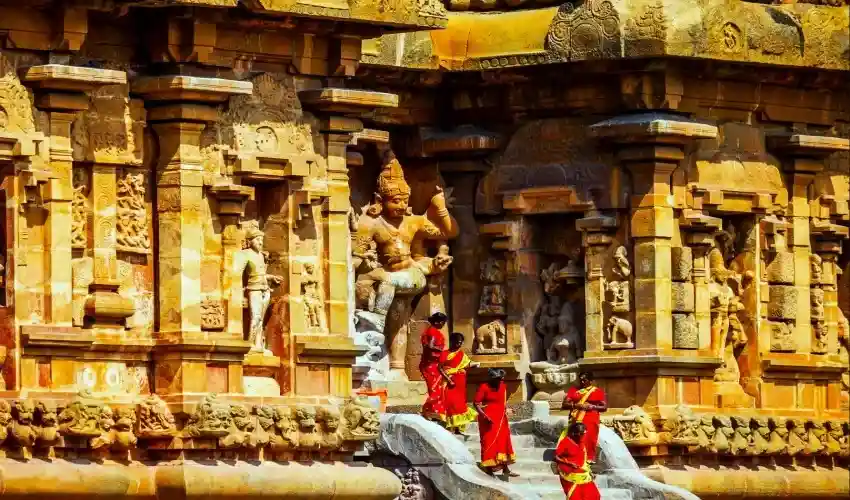
Then drive two hours to Thanjavur. Arrive, check in, walk to Brihadeeswarar Temple before the light fades. Stand in the courtyard and simply look up.
TTI Insider: Ask your guide about the shadow at noon. Then come back tomorrow and stand in the same spot to see it for yourself.
Return to Brihadeeswarar at noon. Stand where your guide marked yesterday. Look for the shadow of the 216-foot vimana — built in 1010 AD, 130,000 tonnes of granite, no binding material, no quarry within 50 kilometres, survived a thousand years and six earthquakes.
The shadow does not fall on the ground. Nobody finds it. That silence is the moment. The afternoon covers the Royal Palace complex and the Chola bronze gallery — among the finest metal sculptures ever made anywhere on earth.
Your guide shares one final detail: the temple height is exactly the number of letters in the Tamil alphabet. Deliberate. Encoded. A thousand years ago.
In time drive to Pondicherry. The drive east reaches the Bay of Bengal and Pondicherry by mid-morning — French street names beside Tamil temples, bougainvillea over colonial yellow walls, the smell of filter coffee from open courtyards. Oernight stay
TTI Insider: The bronze Nataraja in the gallery — look at it for five minutes without reading the label. Then read the label.
In Pondicherry most visitors stay entirely in White Town. Your guide takes you across the canal into the Tamil Quarter — narrower streets, thinnai platforms where elders sit in the evenings, women drawing kolam patterns in rice flour at doorsteps.
This is the beating heart of the city the French Quarter conceals. The afternoon brings Auroville and the Sri Aurobindo Ashram — where a Bengali freedom fighter, hidden from the British by the French consulate, spent his life developing Integral Yoga. In the ashram courtyard — complete silence.
In the evening, the coastal drive north to Mahabalipuram.
TTI Insider: "Spend twenty minutes in the Ashram courtyard without an agenda. The silence there is unlike any other silence on this journey."
A final morning with the Bay of Bengal. The heritage walk covers the Five Rathas, Arjuna's Penance and the Shore Temple — 8th-century rock-cut monuments that have faced the ocean for 1,300 years. The stone carving workshops along the main road are genuine working studios, not tourist displays — walk in, nobody minds.
After lunch, the drive to Chennai International Airport takes one hour. Twenty-five days ago you arrived in Mumbai to begin this South India Walking Journey. You have since walked through six civilisations, failed to milk a cow with extraordinary grace, watched a shadow disappear from a thousand-year-old tower, and sat on the deck of a houseboat as Kerala's backwaters moved silently past. South India does not reveal itself quickly. At walking pace, it reveals itself completely.
TTI Insider: The last morning always feels too short. It is supposed to.
Practical Notes
Activity level: Average 4–7 km per day at a leisurely pace with frequent stops. No specialist fitness required. Guests aged 30–75 complete this tour comfortably every season.
Flights: The tour begins in Mumbai and ends in Chennai. We recommend booking an open-jaw flight — arrive Mumbai, depart Chennai — for the most seamless experience. TTI can assist with domestic flight connections if needed.
Best season: October to March.
This 25-day South India Walking Tour travels from Mumbai to Chennai — privately guided, fully customised, limited departures each season.
Each departure is fully private and customised to your group. TTI Tours plans a limited number of these journeys each season to maintain the quality of every experience.
INCLUDED
- Private English-speaking local guide throughout the 25-day South India Walking Journey
- All accommodation — boutique heritage stays and estate homestays, personally inspected by TTI
- Overnight train journey from Mumbai to Hampi — 2AC class private berths
- Nilgiri Mountain Railway scenic toy train ride from Ooty to Coonoor (subject to confirmation)
- Private houseboat stay in Kerala backwaters — all meals included onboard
- Alleppey backwater canoe ride through narrow village waterways
- Private Kerala cooking class in a Fort Kochi local home
- Kathakali cultural performance — Fort Kochi evening show
- Kalaripayattu martial arts performance — Thekkady evening show
- Kerala village walking experience in Palakkad — pottery, weaving, lunch with local family
- Coffee plantation walk in Kodagu with lunch at the estate
- Bylakuppe Tibetan monastery visit — Namdroling Golden Temple
- Kadamakkudy Island walk — backwater paths and fishing village
- Athangudi tile workshop visit — Chettinad
- Chettinad heritage mansion walking tour
- Rickshaw ride through Madurai temple quarter
- Nature walk inside Periyar Wildlife Sanctuary with naturalist guide
- Tea plantation walk and tasting in Coonoor
- All transfers and sightseeing by private air-conditioned vehicle
- Daily breakfasts at all hotels
- Airport meet-and-greet on arrival in Mumbai
- Private transfer to Chennai International Airport on departure
- 24/7 on-ground TTI support throughout your journey
EXCLUDED
- International flights to/from India
- Domestic flights (if required for customisation)
- Monument and national park entrance fees — including Eravikulam National Park (payable directly at sites)
- Travel insurance (strongly recommended)
- Upgrade to 1AC train cabins (available on request)
- Hotel room category upgrades (subject to availability)
- Optional Ayurvedic treatments in Alleppey
- Visa fees for India
- Lunches and dinners except where explicitly mentioned above
- Personal expenses — laundry, calls, minibar, gratuities
- Any services not explicitly mentioned above
Frequently Asked Questions
The tour includes all accommodation in boutique heritage stays, private guided walks at every destination, all surface transfers between cities, the overnight train from Mumbai to Hampi, a private Kerala houseboat, a Kerala cooking class and a Kathakali evening. Your TTI guide is with you throughout. International flights are not included.
This tour is designed for curious, independent travellers who want South India at depth — not speed. It suits couples, solo travellers and small groups aged 30 to 75 who prefer cultural immersion over checklist sightseeing. No specialist fitness is required. If you have done the North India circuit and want something deeper — this is that journey.
This is a fully private walking journey — not a package. There are no group schedules, no shared coaches, no fixed group sizes. Every day moves at your pace with a private TTI guide who has personally walked every route. The itinerary is customised before departure and can be adjusted throughout the journey.
The average is 4 to 7 kilometres per day at a leisurely pace with frequent stops. This is slow travel — not trekking. Walks are on flat or gently undulating ground through temples, markets, villages, tea estates and heritage sites. The pace is always unhurried and adjusted to match your group on the day.
Yes. Guests aged 30 to 75 complete this tour comfortably every season. The walks are moderate and unhurried — designed for travellers who want depth over distance. No specialist fitness is required. TTI guides always adjust the pace to the group. Many of our most enthusiastic guests on this journey are travelling in their 60s and 70s.
Accommodation throughout is in carefully selected boutique heritage stays — a coffee estate in Kodagu, a restored Chettiar mansion in Chettinad, a traditional houseboat on the Kerala backwaters, and colonial heritage hotels in Fort Kochi and Pondicherry. Every property is personally inspected by TTI and chosen to match the character of each destination.
The tour begins in Mumbai and ends in Chennai. We recommend booking an open-jaw flight — fly into Mumbai International Airport and depart from Chennai International Airport. This routing follows the natural arc of the journey south and avoids any doubling back. TTI meets you at Mumbai airport from the moment you arrive.
October to March is the ideal season. Temperatures are comfortable across all six states, mornings are cool for walking and skies are clear for heritage sites and coastal days. December and January are peak months and book earliest. April to June is hot. The monsoon runs July to September across Kerala and Karnataka.
Yes. Every departure is fully private — built around your group, whether that is one person or six. Solo travellers, couples and small families all travel on this itinerary. If you want extra nights at a specific destination, a different hotel category or an additional experience added, TTI customises the journey before departure.
Book an open-jaw flight — arrive Mumbai, depart Chennai. This is the most seamless routing and avoids returning to your starting point at the end of 25 days. TTI meets you at Mumbai airport on arrival and transfers you to Chennai airport on departure day. Your TTI specialist can advise on domestic connections if needed.
HAVE A QUESTION IN MIND
Looking for more info? Send a question to the tour agent to find out more.
