Overview
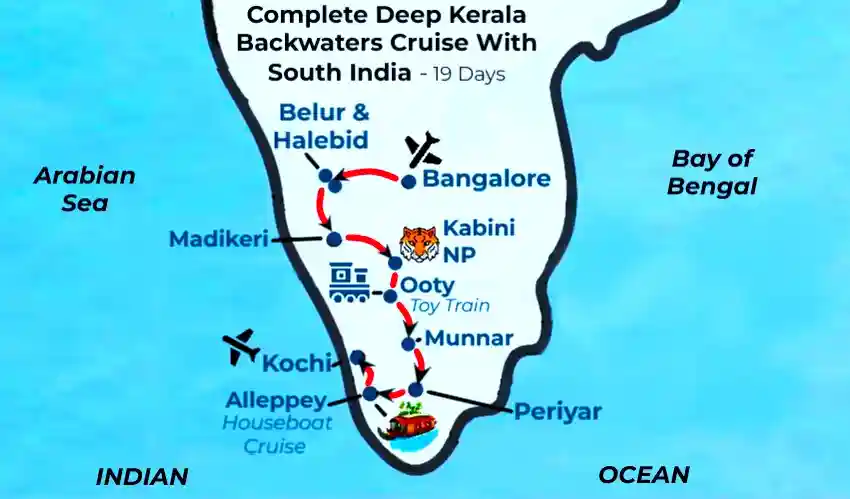
Most South India tours give you one experience. This 19-day private journey gives you four — each completely unlike the other. The Hoysala temples of Hassan are among the most extraordinary stone buildings in the world. Kabini National Park is one of India's finest wildlife reserves — the reservoir at dusk draws elephants, leopards and tigers to the water's edge in numbers that Ranthambore rarely matches. The hill stations of Ooty and Munnar sit at altitudes where the air changes completely. And six consecutive nights on a private Kerala houseboat through Vembanad Lake and the Kuttanad waterways take you deeper into the backwaters than any standard tour reaches. Most Kerala tours give you one night on the backwaters. This one gives you six — long enough to stop being a tourist and start being part of the water. The houseboat is a kettuvallam — a traditional Kerala rice barge built from jackfruit wood, hand-stitched with coconut fibre rope, sealed with fish oil. No nails anywhere in the construction. The vessel is held together by rope and wood, the same way it has been built for centuries. The chef shops at first light from village markets or directly from fishing boats passing on the water. The kettuvallam is one of the most sustainable vessels on water — no synthetic materials, no industrial construction, no engine running through the night. Fly into Bangalore. From that moment — everything is taken care of.
Duration
19 Days 18 Nights
Language
English
Price

HIGHLIGHTS
- Hoysala temples at Belur and Halebid — the dancer whose bangles move after 900 years
- Coorg — the people historians believe descended from Alexander's army
- Kabini National Park — two jeep safaris at dawn and dusk on India's finest wildlife reservoir
- Kabini coracle ride — a round bamboo basket boat, completely silent, along the forest edge
- Elephant crossings on the Bandipur forest road — the driver slows and waits
- UNESCO Nilgiri Mountain Railway — sixteen tunnels, thirty bridges, one hour
- Coonoor — Dolphin's Nose and tea estate walk with naturalist guide
- Munnar — Moon-aar, the land of three rivers at 1,600 metres
- Nilgiri Tahr at Eravikulam — almost extinct, now walking beside you at three metres
- Periyar boat ride — elephants at the water's edge on the forested reservoir
- Periyar forest walk — birds, langurs, the guide's occasional low word
- Kalaripayattu — the speed will shock you. Nothing prepares you for it.
- Six nights on a private kettuvallam — built without nails, held together by rope
- The chef who shops from fishing boats at dawn
- Vembanad Lake — one of the largest freshwater lakes in Asia
- Kavalam — where filmmakers come to photograph the ducks in the paddy
- Below sea level farming — a UN Globally Important Agricultural Heritage System
- The Champakulam snake boat in dry dock — 100 feet of anjili wood you can touch
- Thottappally Spillway — freshwater and saltwater divided by a wall
- Punnamada — the Nehru Trophy course, quiet and empty, the fireflies beginning
- Fort Kochi heritage walk — 500 years of trade in four kilometres
- Kathakali — arrive 90 minutes early. The makeup is the show.
Travel Itinerary
Your TTI representative meets you at Bangalore International Airport. The drive to Hassan takes four to four and a half hours through the Karnataka countryside — small villages, farmland, the landscape gradually greening as the city falls away.
Arrive in the evening and check in. Hassan is not a destination in itself — it is the base for what comes tomorrow. Rest well.
TTI Insider: Do not eat too much tonight. Breakfast before the Hoysala temples is the best meal of this trip — eat early, start early.
The Hoysala dynasty built its temples in the 12th century and then stopped. What they left at Belur and Halebid has not been matched since. The Chennakesava Temple at Belur covers every surface — every centimetre — with carved figures from Hindu mythology, royal life, animals and dancers.
The dancer in the third panel whose bangles move when you tap the pillar below has been moving for 900 years. Halebid, once the Hoysala capital, has two temples side by side — the detail so fine that scholars are still finding figures they had not previously catalogued. Return to Hassan in the evening.
TTI Insider: Stand back from the temple wall first. Take in the whole. Then walk to within a foot of the stone. The shift in what you see is complete.
The drive from Hassan to Coorg takes four to five hours. Coorg is the colonial name — the real name is Kodagu and it has been a distinct cultural region since 300 BCE. The Kodava people are unlike any other community in India — some historians believe they descended from the armies of Alexander the Great who stayed behind after the eastern campaign.
Others trace their origins to Kurdish migrants. Nobody is certain. What is certain is that Kodava culture, cuisine and martial tradition are unlike anything else in Karnataka. Arrive at the resort — a working coffee estate surrounded by mist and hills. Lunch and dinner at the resort.
TTI Insider: Ask your host tonight about the Kodava tradition of keeping a weapon in every home. It is not decoration.
Morning at leisure in Coorg before the drive to Kabini — approximately three hours southeast through the forests of the Western Ghats. Kabini sits on the southern boundary of Nagarhole National Park, one of India's richest tiger reserves.
The Kabini reservoir was created when the Kabini River was dammed — the resulting backwater now draws an extraordinary concentration of wildlife to its shores, particularly in the dry months when water elsewhere in the forest becomes scarce. Arrive in time for the afternoon jeep safari — the first of two.
TTI Insider: At Kabini the animals come to the water. You do not search for them — you wait at the right place at the right time. Your naturalist guide knows the right place.
A full day at Kabini — the best wildlife day of any TTI tour in South India. Morning jeep safari at dawn when the forest is most active — elephants moving to the water, leopards returning from the night, wild dogs hunting in packs through the teak forest.
The coracle ride on the Kabini reservoir follows — a round bamboo basket boat that has been used on these waters for centuries, completely silent, the guide paddling along the forest edge where the trees meet the water and the birds are closest.
Evening jeep safari at dusk — the light on the reservoir at this hour is extraordinary.
TTI Insider: Two safaris in one day at Kabini — morning and evening — are not repetitive. The forest at dawn and the forest at dusk are two completely different places.
Morning drive from Kabini to Ooty — approximately five and a half hours through the Bandipur and Mudumalai forest corridors, the road climbing steadily into the Nilgiri Hills. Elephant crossings on this road are common — the driver knows to slow and wait.
Ooty arrives at 2,240 metres. The temperature drops noticeably as the car climbs. Afternoon at leisure — a walk around Ooty Lake or through the Government Botanical Gardens, 55 acres established by the British in 1848, with a fossilised tree trunk 20 million years old on the front lawn.
TTI Insider: The Botanical Gardens fossil tree is on the main lawn in plain sight. Most visitors walk past it without reading the sign.
A full day in the Nilgiri Hills. The Nilgiri Mountain Railway has been running since 1908 — a UNESCO World Heritage Site, a rack-and-pinion system that climbs gradients no standard train can manage.
The journey from Ooty to Coonoor takes one hour through sixteen tunnels and over thirty bridges, the train pushing through tea gardens and forest, the valley dropping away below.
At Coonoor visit Dolphin's Nose viewpoint and walk through the surrounding tea gardens with a naturalist guide who explains the difference between the flush and the older leaf. Return to Ooty by car. Evening at leisure in the cool mountain air.
TTI Insider: Sit on the left side of the train from Ooty. The valley views from that side are the ones the photographers use.
A six to seven hour drive through the dramatic landscapes of the Western Ghats.
The road passes through forests, waterfalls and tea plantations — each district's tea a different shade of green depending on altitude and rainfall. Munnar appears at 1,600 metres — the air ten degrees cooler than the coast, the smell of the hills completely different from anything in the previous seven days. The locals pronounce it moon-aar — the land of three rivers in Malayalam. Most guests spend two days here without knowing this.
TTI Insider: Open the window on the Munnar drive. The smell of the Western Ghats changes every thirty minutes — try to name what you are smelling.
The morning walk at Eravikulam National Park covers a high rolling plateau at 2,000 metres — open grassland, shola forest, mist moving across the hills. The Nilgiri Tahr grazes here — an endangered mountain goat found nowhere else on earth. By the late 20th century fewer than 100 remained in the wild.
Conservation brought them back. The current population is around 800. One will walk past you at three metres. Nobody is ready for this. The afternoon is free — optional visits to Mattupetty Dam, Echo Point or Top Station for panoramic views of the Western Ghats.
TTI Insider: Do not approach the Tahr — let them approach you. Stand still. They always do.
The drive from Munnar to Thekkady passes through cardamom and pepper plantations — the air changes every few kilometres, each new crop announcing itself before the plant appears. Thekkady sits on the edge of the Periyar Wildlife Sanctuary, one of India's finest reserves.
After check-in, a spice plantation walk with a naturalist guide — each plant introduced by smell before name. Cinnamon bark peeled and handed over. A cardamom pod broken open. Black pepper on the vine. Most guests have been cooking with these spices for decades without knowing what the plant looks like.
TTI Insider: Break open a cardamom pod and hold it close. Your guide will tell you something about it that you will repeat for the rest of your life.
Morning boat ride on Periyar Lake inside the wildlife sanctuary — the forested shores visible on all sides, elephants sometimes visible at the water's edge in the early hours.
A guided forest walk follows — the trail flat and gentle, completely quiet except for the guide's occasional low word. Birds, giant squirrels, Malabar langurs in the canopy above.
The evening brings a Kalaripayattu performance — Kerala's ancient martial art, believed by some historians to be the system from which all Asian martial arts descended. The speed and precision of the performers is genuinely shocking.
TTI Insider: Arrive early for Kalaripayattu. The warm-up alone is worth watching — it is where the real discipline shows.
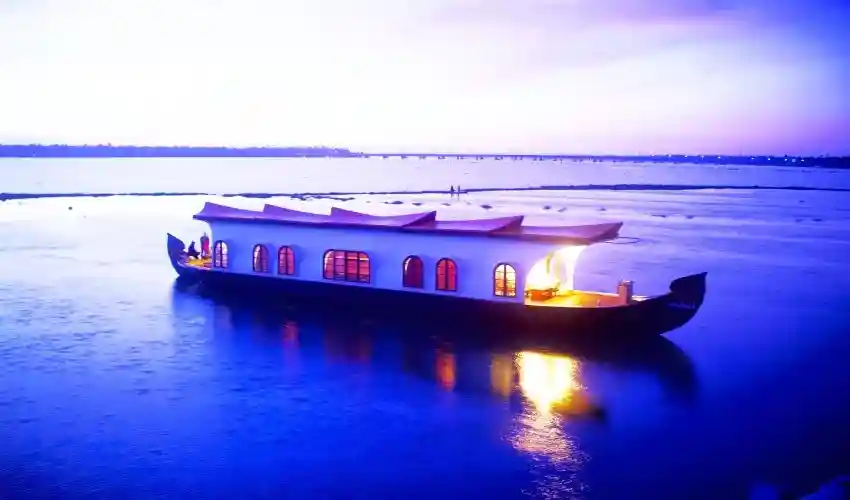
Drive to Alleppey and board your private houseboat at noon. The crew — captain, chef and assistant — are introduced on the dock. The kettuvallam is built from jackfruit wood, hand-stitched with coconut fibre rope, sealed with fish oil.
No nails anywhere in the construction. The vessel is held together by rope and wood — the same method used for centuries to carry rice through these waterways. The first hour on Vembanad Lake — one of the largest freshwater lakes in Asia — is simply the horizon and the water and the sound of the engine going quiet when you reach the open lake.
TTI Insider: The first dinner on the houseboat is simple — rice, chapatti, dal, chicken curry, vegetables cooked in coconut. Everything prepared on a wood fire in a galley the size of a cupboard. Eat on the deck. Watch the water. Nothing about the meal is complicated. Everything about it is exactly right.
Morning cruise through Cherukali Kayal into the quieter reaches of the backwater network. The houseboat moves toward Kavalam — a village on the banks of Vembanad in the Kuttanad district, criss-crossed by canals and full of ducks that filmmakers have been coming here to photograph for decades.
After lunch on the water, the cruise continues toward Kidangara for the evening anchor. After mooring, guests can walk into the village independently.
TTI Insider: Kavalam is where filmmakers come to photograph Kerala. Not because of any single landmark — because of how the paddy fields, the duck flocks, the canal light and the village pace all arrive at the same time. Stand on the deck and be quiet. Let it come to you.
Morning cruise through the Kuttanad waterways toward Ramankary — a village on the bank of the Manimala River with paddy fields stretching to the horizon in every direction.
A guided village walk through the fields — the rice grown here feeds much of Kerala. The houseboat passes Thekkekkara and Mancompu through the afternoon. The Pulinkunnu River — where the Rajiv Gandhi Boat Race is held annually — widens enough to see both banks clearly. Evening anchor at Nedumudy.
TTI Insider: The Kuttanad region is the only place in Asia where farming is done below sea level. The fields are not flooded. They are held back by bunds that have been maintained for over a thousand years.
The houseboat sails toward Champakulam — the rice bowl of Kerala, green paddy fields and waterfowl on every bank. The River Pampa flows through the village splitting it into two.
The snake boat at Champakulam sits in dry dock outside race season — 100 feet long, carved from a single anjili wood trunk, built to carry 100 oarsmen.
Most visitors only see snake boats racing. This one you can stand beside and touch. The scale of it is genuinely shocking. Evening anchor at Thakazhi.
TTI Insider: The Champakulam snake boat — put your hand on the hull. The wood has been in the water for decades. It tells you everything about how these boats are built to last.
Morning cruise from Thakazhi through Thennady and Payippad to Thottappally — an active fishing harbour where the catch arrives at the dock throughout the morning.
The Thottappally Spillway separates the freshwater of the lake from the saltwater at the river mouth draining into the Arabian Sea. Stand at the spillway — freshwater on one side, saltwater on the other, the line between them visible.
A short walk to Thottappally Beach — quiet, almost empty, the Arabian Sea at the end of the backwater journey. Evening anchor at Karumadi.
TTI Insider: At the Thottappally Spillway — put one hand on each side. Freshwater and saltwater separated by a wall a few feet wide. This is where two worlds meet.
The final full day on the water. Morning cruise through Karimba Valavu and the Muttathodu and Pallathuruthy canals — narrower waterways where village life on either side comes within arm's reach.
Meenappally Lake and then back into Vembanad — the vast open water of India's longest lake. The Nehru Trophy Boat Race course crosses this water every August — today it is empty and quiet.
Overnight anchor at Punnamada — the last evening on the water. The houseboat stops at sunset. No engine noise. The fireflies begin.
TTI Insider: The last evening on the houseboat — sit on the deck after dinner. The silence on the backwaters after sunset is unlike any silence you will have heard on this journey.
Morning checkout from the houseboat at Pallathuruthy and transfer to Fort Kochi — forty kilometres north along the Malabar Coast.
Fort Kochi is where 500 years of trade history occupy four kilometres of colonial lanes — Portuguese, Dutch, Jewish, Chinese and Indian history layered on the same streets. A guided heritage walk covers St Francis Church, the Dutch Palace murals, Mattancherry Spice Market and the Jewish Synagogue.
The evening belongs to Kathakali. Arrive ninety minutes before the performance. The makeup transformation is the show within the show.
TTI Insider: Watch the performer's eyes during the makeup. Kathakali expression begins in the eyes long before the costume is complete.
A final morning in Fort Kochi — coffee at a café on the colonial lanes, the Chinese fishing nets visible from the waterfront. Then transfer to Cochin International Airport — twenty minutes by road. Nineteen days ago you arrived in Bangalore. The Hoysala temples, the coffee hills, two jeep safaris at Kabini, the mountain railway, the Nilgiri Tahr at three metres, six nights on the water, a spillway where two worlds meet — all of it behind you now.
Open-jaw flights recommended — arrive Bangalore, depart Kochi.
Tour ends: Kochi
Activity level: Moderate. Heritage walks average 3-5 km at relaxed pace. Jeep safaris and houseboat days involve minimal walking. Suitable for guests aged 30 to 75. No specialist fitness required.
Wildlife note: Animal sightings on safari are subject to natural conditions and cannot be guaranteed. TTI works with experienced naturalist guides who know the Kabini forest and Periyar sanctuary intimately.
Flights: The tour begins in Bangalore and ends in Kochi. Open-jaw flights recommended — arrive Bangalore, depart Kochi.
Best season: October to March overall. February to May for peak Kabini wildlife. November to February for peak backwaters.
This 19-day private South India journey travels from Bangalore to Kochi — privately guided, fully customised, limited departures each season.
TTI Tours · Delhi-based team of on-ground specialists · 15+ years designing private journeys across India · travelindiatourindia.com
WhatsApp: +919310054485
INCLUDED
- Private English-speaking local guide and naturalist throughout the 19-day journey
- All accommodation — boutique heritage stays, wildlife lodges and estate properties personally inspected by TTI
- Private houseboat — six nights in the Kerala backwaters — all meals included onboard
- Two jeep safaris at Kabini National Park — morning and evening
- Coracle ride on the Kabini reservoir
- Periyar boat ride on Periyar Lake inside the wildlife sanctuary
- UNESCO Nilgiri Mountain Railway toy train ride — Ooty to Coonoor (subject to confirmation)
- Tea estate walk with naturalist guide — Coonoor
- Nature walk inside Periyar Wildlife Sanctuary with naturalist guide
- Spice plantation walk and tasting — Thekkady
- Kalaripayattu martial arts performance — Thekkady evening
- Kathakali cultural performance — Fort Kochi evening
- Fort Kochi heritage walk
- All transfers and sightseeing by private air-conditioned vehicle
- Daily breakfasts at all hotels
- Airport meet-and-greet — Bangalore arrival
- Private transfer to Cochin International Airport on departure
- 24/7 on-ground TTI support throughout your journey
EXCLUDED
- International flights to/from India
- Domestic flights (if required for customisation)
- Monument and national park entrance fees — including Eravikulam and Kabini — payable directly at sites
- Travel insurance — strongly recommended
- Hotel room category upgrades — subject to availability
- Optional Ayurvedic treatments — available at selected properties on request
- Visa fees for India
- Lunches and dinners except where explicitly stated above
- Personal expenses — laundry, calls, minibar, gratuities
- Any services not explicitly mentioned above
Frequently Asked Questions
Kabini sits on the Kabini reservoir — a body of water that draws an extraordinary concentration of wildlife to its shores, particularly in the dry season when water elsewhere in the forest becomes scarce. Elephants, leopards, tigers and wild dogs all come to this water. The density of sightings here consistently matches or exceeds Ranthambore. Two safaris in one day — morning and evening — cover the forest at its two most active hours.
Kabini is part of Nagarhole National Park — one of India's richest tiger reserves. Elephants are seen almost every safari. Leopards, wild dogs, gaur, spotted deer and hundreds of bird species are regularly sighted. Tiger sightings are possible but cannot be guaranteed on any safari anywhere. The coracle ride along the forest edge offers birdwatching and close wildlife encounters that the jeep safari cannot reach.
This tour gives you six consecutive nights on the backwaters — the longest private houseboat journey TTI offers. A standard one-night stay covers the same short stretch of water. Six nights takes you deep into the Kuttanad waterway network — Kavalam, Ramankary, Champakulam, Thottappally, Punnamada — places that genuinely feel remote and unhurried. The experience changes completely after the second night.
The tour combines gentle walking days, jeep safari days, driving days and six houseboat days. Heritage walks at Belur, Halebid, Periyar and Fort Kochi average 3 to 5 kilometres at a relaxed pace. The Eravikulam plateau walk is approximately 4 kilometres on flat open terrain. Jeep safari and houseboat days involve minimal walking. The pace changes completely once you board the houseboat.
Yes. Guests aged 30 to 75 complete this tour comfortably every season. The jeep safari days are seated throughout. The houseboat days are the most relaxed days of the entire journey — no walking required. Walking days are gentle and unhurried. TTI guides always adjust the pace to the group on the day.
The private houseboat includes a bedroom with en-suite bathroom, open deck, air conditioning, a captain, a chef and an assistant. All meals are prepared onboard using fresh locally sourced ingredients — breakfast, lunch and dinner included for all six nights. The chef shops each morning from village markets or directly from fishing boats. Meals are Kerala cuisine — fish curry, rice preparations, fresh coconut dishes. The kettuvallam itself is built without synthetic materials — jackfruit wood, coconut fibre rope, fish oil — making it one of the most eco-friendly vessels on the water
The tour begins in Bangalore and ends in Kochi. We recommend booking an open-jaw flight — fly into Kempegowda International Airport Bangalore and depart from Cochin International Airport. TTI meets you at Bangalore airport on arrival and transfers you to Kochi airport on departure day.
October to March is the ideal season overall. For the best wildlife experience at Kabini, February to May is peak season — water levels drop and animals concentrate near the reservoir. For the backwaters, November to February offers the most beautiful light and comfortable temperatures on the houseboat deck. October to March works well for all elements of this tour combined.
Accommodation includes a heritage resort in Hassan, a coffee estate in Coorg, a wildlife lodge at Kabini, a hill station property in Ooty, a tea garden hotel in Munnar, a wildlife retreat in Thekkady, six nights on a private premium houseboat in the backwaters, and a colonial heritage hotel in Fort Kochi. Every property is personally inspected by TTI.
Yes. Every TTI departure is fully private and customised to your group. Extra nights at Kabini or Munnar, a different hotel category, an Ayurvedic programme added to the houseboat days — TTI builds the adjustments before departure. Contact us and we respond within a few hours.
HAVE A QUESTION IN MIND
Looking for more info? Send a question to the tour agent to find out more.
