Taj Mahal at Sunrise — The Complete Visitor Guide | TTI Tours
tti tours / 08/03/2026
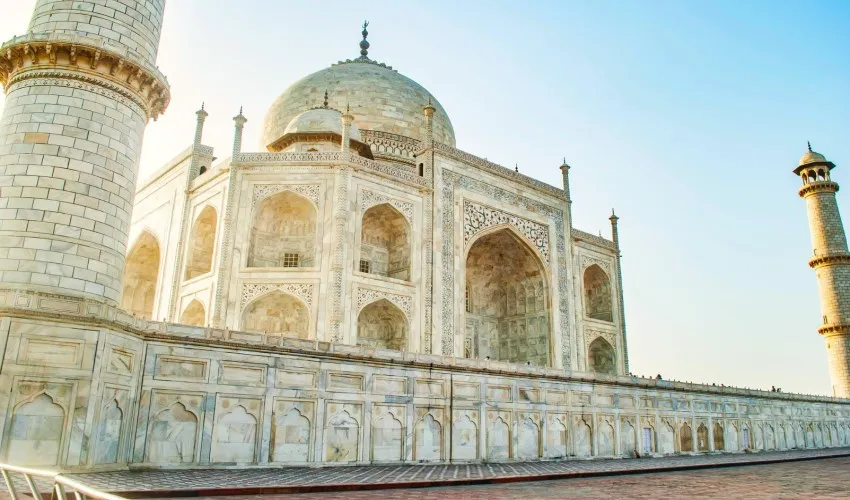
Taj Mahal
at Sunrise
The complete visitor guide — what to see, when to arrive, what to expect and how to make the most of the world's greatest monument to love.
There is a moment — and every visitor to the Taj Mahal knows this moment even before they arrive — when you walk through the Great Gate and the world changes. The marble appears. The reflecting pool stretches before you. The minarets rise on either side. And the Taj Mahal itself stands at the end of it all, white and impossible and completely, utterly real.
No photograph has ever captured it correctly. No documentary has ever conveyed what it feels like to stand in front of it for the first time. The scale is wrong in every image — in reality it is both larger and more delicate than you imagined. The colour shifts with every degree of light. At sunrise it is pink. By mid-morning it is white. By afternoon it is gold.
This guide tells you everything you need to know to experience the Taj Mahal at its absolute best — the right time to arrive, what to expect hour by hour, the tips that make the difference between a good visit and one you will describe for the rest of your life.
"No photograph, no documentary, no description prepares you for what you feel the first time you see the Taj Mahal."
— Every TTI Tours Guest, Every Year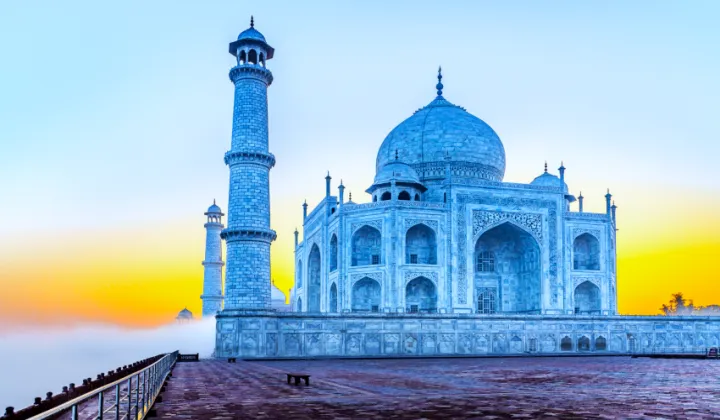
The Taj Mahal at sunrise — the most breathtaking 90 minutes in all of India
The Taj Mahal is closed every Friday for prayers at the mosque within the complex. TTI Tours schedules your Agra visit on the correct day and automatically adjusts the itinerary if Day 3 of your tour falls on a Friday. If you are visiting independently, always check the day of the week before booking your Agra hotel.
Delhi to Agra — How to Get to the Taj Mahal
Agra is approximately 200 kilometres south of New Delhi — a journey of 3.5 to 4 hours by road on the Yamuna Expressway, one of India's best maintained highways. On the TTI Tours Golden Triangle tour, your private driver picks you up from your Delhi hotel and delivers you directly to your Agra hotel the evening before your Taj Mahal visit — so you are already in Agra and ready for the 6:00 AM start.
Always stay in Agra the night before your Taj Mahal visit — never attempt a same-day trip from Delhi. The Taj Mahal opens at sunrise and the first 90 minutes offer the best light, smallest crowds and the most extraordinary experience. Arriving from Delhi on the morning of your visit means missing sunrise entirely.
Taj Mahal at Sunrise — Hour by Hour
Here is exactly what happens on a TTI Tours Taj Mahal sunrise visit — from the moment you leave your Agra hotel to the moment you walk back through the Great Gate.
Your TTI Tours guide meets you in the hotel lobby at 5:30 AM. The streets of Agra are quiet at this hour — the city has not yet woken up. Your private vehicle takes you the short distance to the South Gate of the Taj Mahal complex — the gate used for guided tours — arriving approximately 20 minutes before opening.
The Taj Mahal opens at sunrise — approximately 6:00 AM year-round. Being among the first visitors through the gate is the single most important thing you can do on this visit. The early morning crowd is a fraction of the afternoon crowd. Your guide leads you through security — shoes covered, bags checked — and you walk toward the Great Gate.
You pass through the Great Gate — the enormous red sandstone gateway — and the Taj Mahal appears for the first time framed perfectly within the arch. This is the moment. Everything you have seen in photographs becomes real — and nothing you have seen in photographs has prepared you for this. Your guide pauses here and says nothing. He has learned that silence is the only right response.
Your guide leads you along the central pathway toward the Taj Mahal, stopping at the central reflecting pool — the Hauz-i-Kausar — where the Taj Mahal is mirrored perfectly in still water. The pink morning light reflects in the pool. This is the most photographed viewpoint in India and at 6:30 AM you will have space to stand, breathe and appreciate it properly.
You ascend the marble plinth and enter the main mausoleum. Inside, your guide points out the extraordinary pietra dura inlay work — semi-precious stones set into white marble in floral patterns so intricate they appear almost alive. At the centre of the chamber are the cenotaphs of Emperor Shah Jahan and his beloved wife Mumtaz Mahal. The actual tombs lie below in a sealed crypt.
After the guided tour of the main mausoleum, your guide gives you free time to explore the complex at your own pace — the mosque to the west, the guest house to the east, the garden terraces and the river views from the back of the platform. This is when most guests take their best photographs — the light is still good and the crowds are still manageable.
You exit the Taj Mahal complex by 8:30 AM — before the large tour groups and day visitors arrive from Delhi. Your vehicle takes you directly to Agra Fort — approximately 10 minutes away — for a guided tour of the magnificent red sandstone fortress where Shah Jahan spent his final years as a prisoner, gazing at the Taj Mahal from the Tower of Jasmine.
You are standing at the reflecting pool at 6:20 in the morning. The sky is pale pink and the air is cool and completely still. The Taj Mahal rises at the end of the pool — white marble flushed rose in the first light, reflected perfectly in the water below. There are perhaps thirty other people in the entire garden. Your guide is beside you but says nothing. You understand, in this moment, why people travel halfway around the world for this.
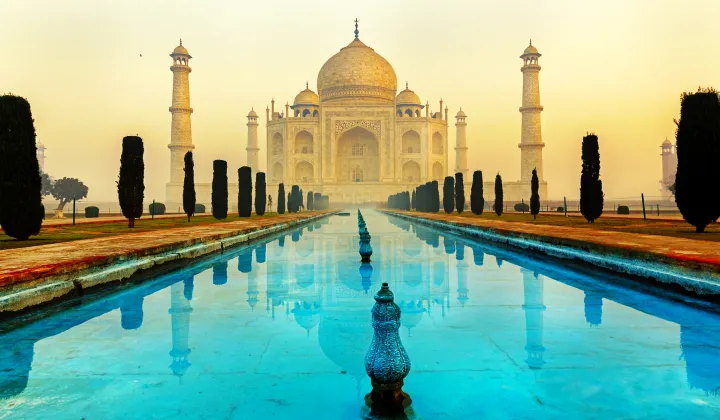
The Taj Mahal reflected in the Hauz-i-Kausar pool — the most iconic view in India, best seen at sunrise
Entry Fees, Opening Hours & Essential Facts
The Taj Mahal was built between 1631 and 1653 — taking 22 years to complete. Over 20,000 artisans worked on it, sourcing materials from across Asia. The white marble came from Rajasthan, the jasper from Punjab, the jade and crystal from China, the turquoise from Tibet and the sapphire from Sri Lanka. It is genuinely the most expensive building ever built in its time.
Best Time of Year for the Taj Mahal
| Season | Conditions | Verdict |
|---|---|---|
| Oct – Nov | 25–32°C · Clear skies · Post monsoon greenery | ✅ Excellent |
| Dec – Jan | 8–20°C · Occasional morning mist · Winter light | ✅ Best Overall |
| Feb – Mar | 18–28°C · Clear · Ideal temperatures | ✅ Very Good |
| Apr – Jun | 38–45°C · Haze · Intense heat by 9 AM | ⚠️ Challenging |
| Jul – Sep | Monsoon · Humidity · Occasional rain | ⚠️ Not Ideal |
December and January occasionally bring morning mist to Agra — which creates an extraordinary effect where the Taj Mahal appears to float above the fog. This is rare but when it happens it is one of the most spectacular natural displays at the monument. It cannot be predicted but if you visit in December or January there is a chance you will witness it.
Taj Mahal Photography — The Essential Tips
Arrive at Opening
The sunrise light is pink, soft and directional. By 9 AM the light is harsh and white. The first 90 minutes are the only time for great Taj Mahal photographs.
Use the Pool
The central reflecting pool gives the classic mirror image. Crouch low for the best reflection — the lower your angle the more of the Taj appears in the water.
Side Angles
Walk to the left or right of the central axis for a different perspective. The Taj Mahal photographed from the corners of the garden reveals its full 3D form.
Tripods Not Allowed
Tripods are not permitted inside the Taj Mahal complex. Use a monopod if needed or simply use the garden benches and walls for stability in low light.
Phones Work Well
Modern smartphones photograph the Taj Mahal beautifully — especially at sunrise. Portrait mode on the pool shot creates a stunning depth of field effect.
Beat the Groups
Large tour groups arrive at 9–10 AM. By then the central pathway is crowded. Get your key shots before 8 AM and move to the mausoleum when groups arrive outside.
What to Wear & What to Know
There is no strict dress code at the Taj Mahal for foreign visitors — but respectful, comfortable clothing is strongly recommended. The complex requires removing shoes to enter the mausoleum — shoe covers are provided free at the entrance.
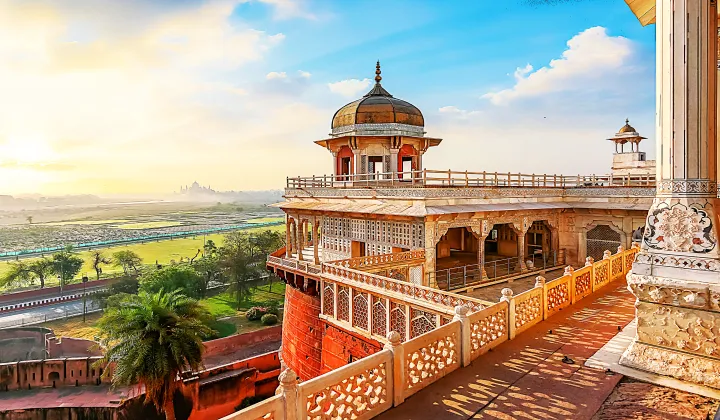
Agra Fort — the magnificent red sandstone fortress visited after the Taj Mahal on Day 3 of the tour
Agra Fort — The Story Behind the Story
No visit to Agra is complete without Agra Fort — the magnificent red sandstone fortress that served as the main residence of the Mughal Emperors for generations and holds the most poignant chapter of the Taj Mahal story.
After completing the Taj Mahal and imprisoning his father within Agra Fort, Shah Jahan's own son Aurangzeb turned the tables — imprisoning Shah Jahan himself in the Tower of Jasmine within the fort. From this tower, for the last eight years of his life, Shah Jahan could see the Taj Mahal he had built for his wife — but could never reach it. He died gazing at it.
Visiting both the Taj Mahal and Agra Fort on the same morning gives you the full story — the monument and the man who built it — in a way that no single visit alone can provide.
From the Tower of Jasmine in Agra Fort — known as Musamman Burj — you can see the Taj Mahal clearly across the Yamuna River. On the day Shah Jahan died in 1666, he was found at the window of this tower, facing the Taj Mahal. He was buried beside Mumtaz Mahal in the tomb he had built for her — the only asymmetric element in an otherwise perfectly symmetrical monument.
🗺️ The Taj Mahal at sunrise and Agra Fort are visited on Day 3 of our 8 Day Golden Triangle Rajasthan Tour — from USD 820 per person. All entry fees, private guide, transfers and Friday-proof scheduling are included. No logistics — just the experience.
Trusted by travellers worldwide
⭐⭐⭐⭐⭐ Rated Excellent · TTI Tours
🟢 Read Our Reviews on TripAdvisor →Experience the Taj Mahal at Sunrise
Day 3 of the Golden Triangle Rajasthan Tour — guided visit, entry fees included, Friday-proof scheduling. No logistics. Just the moment.
💬 WhatsApp Us — Get a Quote in 1 Hour
Blogs Frequently Asked Questions
Related Travel Guides

Recent Comments
Just wrapped up the most incredible Luxury Golden Triangle Tour in India! Every detail was flawlessly managed, from opulent stays to seamless experiences. Huge thanks to Ashu, our amazing travel agent, for making it truly unforgettable. Highly recommend for a premium journey!
Subcategories
Famous India Tours
Festivals In India

Leave a Comment