Rajasthan Food Guide — What to Eat & Where | TTI Tours
tti tours / 10/03/2026
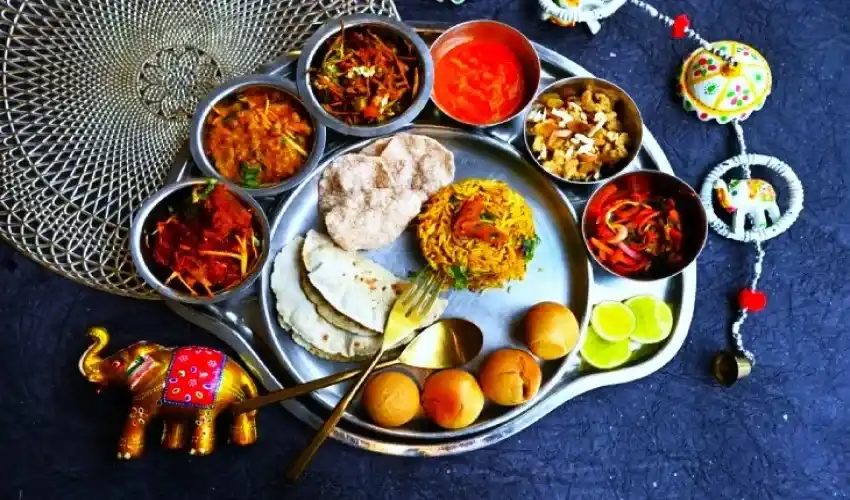
Rajasthan Food Guide
What to Eat & Where
The food of Rajasthan is as bold and vivid as its cities — shaped by the desert, the royal kitchens and centuries of spice trade.
Rajasthani food was born from necessity — and became one of the most distinctive cuisines in the world.
In a desert state with scarce water and extreme heat, the people of Rajasthan developed a cuisine built to last — dried lentils, preserved vegetables, slow-cooked meats, deep-fried breads and rich dairy. The spices are not decoration — they preserve food, cool the body in heat and warm it in cold desert nights.
Rajasthan cuisine is one of the most distinctive culinary traditions in India — and one of the least known outside the country. The result is food of extraordinary depth and character. The same dish tastes different in Jaipur, Jodhpur and Jaisalmer — because every city has its own culinary personality. This guide tells you what to eat, where to eat it and what to look for on your plate.
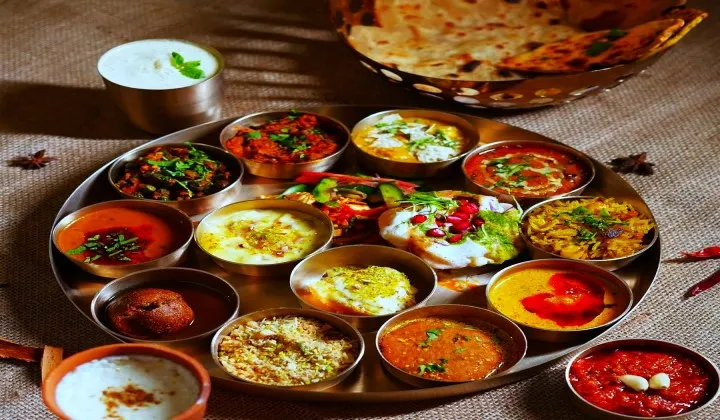
A Rajasthani Thali — the complete spread of Rajasthan's greatest dishes on a single plate
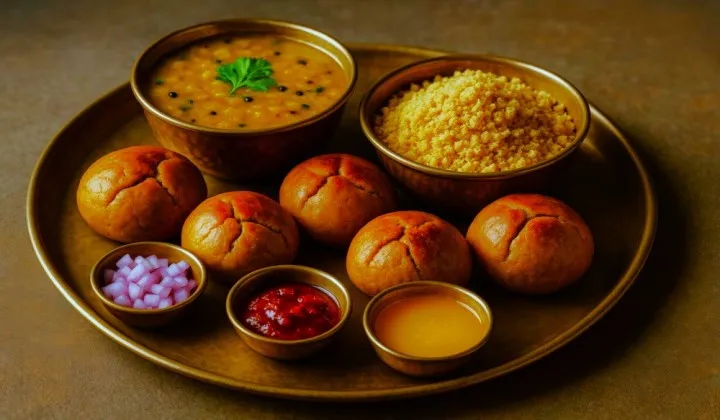
Dal Baati Churma is the defining dish of Rajasthan — a trio of three distinct elements that come together on one plate to create something extraordinary. It is the dish every guide will recommend, every restaurant will serve and every visitor will remember long after leaving India.
Baati are dense wheat balls baked traditionally in a cow-dung fire or a clay oven until they form a hard golden crust outside and a soft, steaming interior. They are cracked open and drenched in generous amounts of pure ghee. Dal is a rich five-lentil curry — deeply spiced with cumin, coriander, turmeric and red chilli — poured over or alongside the baati. Churma is the sweet counterpart — coarsely ground wheat crushed with ghee and jaggery, providing a sweet contrast to the savoury dal. The combination of the three together — savoury, rich and sweet on the same spoonful — is unlike anything else in Indian cuisine.
Traditionally a warrior food, Dal Baati Churma was designed to be cooked on a campfire and eaten in the field. The baatis were buried in the embers of the fire — requiring no water, keeping for days and providing intense energy. The desert gave Rajasthan its greatest dish.
- Jaipur — Chokhi Dhani village resort — the most theatrical setting in Rajasthan
- Jaipur — LMB (Laxmi Misthan Bhandar) — old city institution since 1954
- Jodhpur — Gypsy restaurant — rooftop with Mehrangarh Fort views
- Jaisalmer — Trio Restaurant — fort views with traditional Rajasthani thali
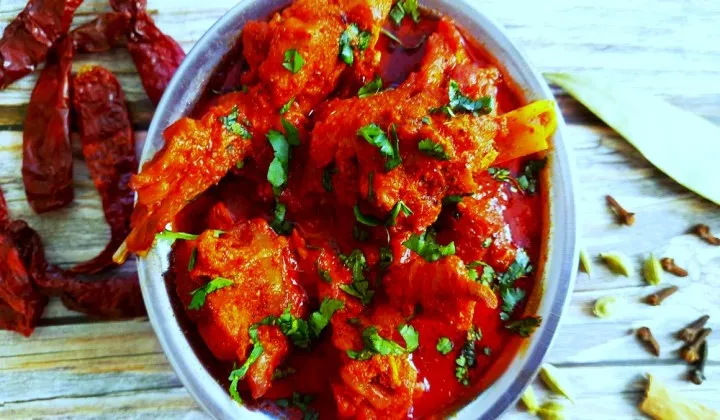
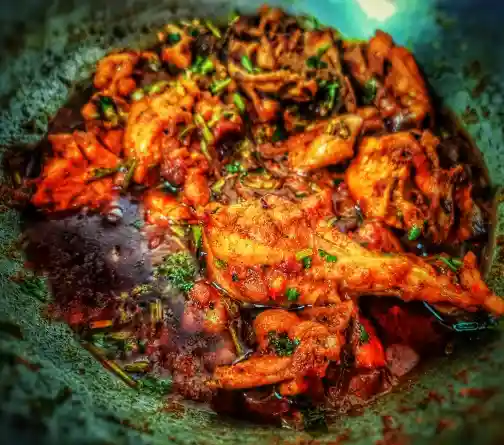
Laal Maas — literally meaning Red Meat — is the most celebrated non-vegetarian dish in Rajasthan and one of the great curries of India. It was born in the royal hunting kitchens of the Rajput maharajas, originally made with wild boar or game meat hunted during royal expeditions. Today it is made with mutton — slow-cooked until the meat falls apart in a fierce, crimson sauce.
The colour and heat come from the Mathania chilli — a variety grown exclusively in the village of Mathania near Jodhpur, known for its deep brick-red colour and intense but complex heat. The sauce is built on yoghurt, garlic, and a base of whole spices — the yoghurt tenderising the meat over hours of slow cooking and tempering the fire of the chillies into something rich and layered rather than simply hot.
Authentic Laal Maas is cooked in a brass or copper vessel over a wood fire. The smell when the lid is lifted — garlic, chilli and roasted meat — is one of the most intoxicating aromas in Indian cooking. It is eaten with bajra roti — flatbread made from pearl millet — which absorbs the sauce completely.
- Jodhpur — Mihir Garh — considered the best Laal Maas in Rajasthan
- Jodhpur — On the Rocks restaurant — open-air dining with live cooking
- Jaipur — Handi Restaurant — traditional Rajasthani cooking in clay pots
- Jaisalmer — Killa Bhojnalaya — inside the fort walls with desert views
The Mathania chilli used in Laal Maas is grown in a single village near Jodhpur and has a Geographical Indication tag — meaning only chillies grown in Mathania can be called Mathania chillies. The variety is prized not just for heat but for its deep red colour, which gives Laal Maas its extraordinary appearance. Without Mathania chilli, Laal Maas is simply not Laal Maas.
Gatte ki Sabzi is the dish that best illustrates the ingenuity of Rajasthani cooking. In a desert with no fresh vegetables and scarce water, the people of Rajasthan invented a vegetable dish made entirely from chickpea flour — gram flour mixed with spices, rolled into cylinders, boiled and then cooked in a tangy yoghurt-based gravy.
The result is deeply satisfying — the gatte have a firm, slightly chewy texture that soaks up the yoghurt gravy beautifully. The gravy is tempered with mustard seeds, curry leaves and red chilli, giving it a complex base note of sourness and spice. It is eaten with bajra roti or rice and is a fixture on every Rajasthani thali.
What makes Gatte ki Sabzi remarkable is what it reveals about Rajasthani cooking philosophy — nothing is wasted, nothing requires fresh ingredients that the desert cannot provide, and the simplest raw materials are transformed by skill and spice into something memorable.
- Any traditional Rajasthani thali restaurant in Jaipur, Jodhpur or Jaisalmer
- Jaipur — Samode Haveli restaurant — heritage courtyard dining
- Jodhpur — Indique rooftop restaurant — fort views and traditional menu
Ker Sangri is the dish you will not find anywhere else in the world — made from two wild ingredients that grow only in the Thar Desert. Ker is a small wild berry that grows on thorny bushes in the desert. Sangri is the dried bean of the khejri tree — the sacred tree of Rajasthan, capable of surviving years without rain.
Both ingredients are dried in the sun to preserve them through the year, then soaked and cooked together with desert spices — dried mango powder, red chilli, turmeric and mustard seeds. The result is a dry, intensely flavoured preparation with a sour-spicy character unlike anything in mainstream Indian cooking. The taste of Ker Sangri is the taste of the Thar Desert itself.
Ker Sangri is not just food — it is a marker of identity. Eating it in Jaisalmer, in the shadow of the golden fort, with the desert stretching beyond the city walls, is one of those food experiences that connects you to a place in a way that no amount of sightseeing can replicate.
- Jaisalmer — Trio Restaurant — the best traditional menu inside the fort
- Jaisalmer — Desert Boy's Dhani — authentic village-style cooking
- Sam Sand Dunes desert camp — served as part of the traditional camp dinner
The best way to eat in Rajasthan is always the thali — a large metal plate with small bowls of six to twelve different dishes surrounding a central mound of rice or bread. A good Rajasthani thali will contain Dal Baati, Gatte ki Sabzi, Ker Sangri, a sweet dish and several other preparations. It is unlimited — the servers will refill your bowls until you signal them to stop. Always order the thali on your first meal in each city.
Ghevar is Rajasthan's most iconic dessert — a disc-shaped sweet made from a batter of flour, ghee and water, poured in a thin stream into hot oil to create an extraordinary honeycomb lattice structure. The resulting disc is soaked in sugar syrup, topped with thickened cream — rabri — and finished with saffron, rose water, pistachios and silver leaf.
The texture is unlike any other sweet in India — simultaneously crispy and syrup-soaked, with the rabri adding a cool, rich creaminess against the crunch. The saffron turns the cream pale gold. The rose water gives it a floral lightness. The whole effect is simultaneously indulgent and delicate — a dessert that looks and tastes like something from a royal banquet, because it is.
Ghevar is traditionally associated with the Teej and Raksha Bandhan festivals — August and September — but is available year-round in Jaipur's sweet shops. The old city of Jaipur has the finest ghevar makers in Rajasthan, with some shops having made it for over a hundred years.
- Jaipur — LMB (Laxmi Misthan Bhandar) — the most famous sweet shop in the Pink City
- Jaipur — Rawat Mishtan Bhandar — old city institution, queues out the door
- Jaipur — Johari Bazaar — multiple sweet shops along the main bazaar street
Traditional Food of Rajasthan
The traditional food of Rajasthan reflects desert life — limited water, extreme heat and a deep tradition of spice and preservation. Rajasthan cuisine developed over centuries in conditions where fresh vegetables were scarce, water was precious and food needed to last for days in the heat. The result is a culinary tradition built on dried lentils, chickpea flour, preserved desert vegetables, slow-cooked meats and rich dairy — all brought alive by the most complex spice blends in India.
The most famous food of Rajasthan includes Dal Baati Churma — the iconic lentil and baked wheat dish eaten across the state — Laal Maas, the fierce red mutton curry of the royal kitchens, Gatte ki Sabzi made from chickpea flour dumplings, Ker Sangri made from wild desert berries and beans, and Ghevar — the honeycomb festival sweet of Jaipur. Each dish is a direct product of the land it comes from and the people who created it.
Eating traditional Rajasthani food in the cities where it was created — Jaipur, Jodhpur and Jaisalmer — is one of the most rewarding parts of any visit to Rajasthan. The TTI Tours 8 Day Golden Triangle Rajasthan Tour includes dedicated time in each city with guides who know exactly where to eat.
Rajasthan Food — Quick Reference Guide
| Dish | Type | Heat | Best City | Tour Day |
|---|---|---|---|---|
| Dal Baati Churma | 🟢 Veg · Signature | 🌶️🌶️ | Jaipur / Jodhpur | Day 4–6 |
| Laal Maas | 🔴 Non-Veg · Curry | 🌶️🌶️🌶️🌶️ | Jodhpur | Day 6 |
| Gatte ki Sabzi | 🟢 Veg · Curry | 🌶️🌶️ | All cities | Any day |
| Ker Sangri | 🟢 Veg · Dry | 🌶️🌶️🌶️ | Jaisalmer | Day 7–8 |
| Ghevar | 🟢 Veg · Sweet | 🍯🍯🍯🍯 | Jaipur | Day 4–5 |
| Bajra Roti | 🟢 Veg · Bread | — | All cities | Any day |
| Rajasthani Thali | 🟢 Veg · Full meal | 🌶️🌶️ | All cities | Any day |
Rajasthani cooking uses very little water — a direct response to desert scarcity. Instead, ghee (clarified butter), yoghurt and buttermilk are used as cooking liquids. This gives Rajasthani food its distinctive richness and helps preserve it in the heat. A traditional Rajasthani dal cooked in ghee will keep for days without refrigeration — one of the reasons this cuisine developed such deep, concentrated flavours.
🍽️ All dishes in this guide are eaten across the 8 days of the TTI Tours Golden Triangle Rajasthan Tour — from USD 820 per person. Your expert local guide in each city will take you to the right restaurants — not tourist traps. WhatsApp us to book or ask any question.
Trusted by travellers worldwide
⭐⭐⭐⭐⭐ Rated Excellent · TTI Tours
🟢 Read Our Reviews on TripAdvisor →Eat Your Way Through Rajasthan
8 days · Private guides · Right restaurants in every city · From USD 820 per person
💬 WhatsApp Us — Get a Quote in 1 Hour
Blogs Frequently Asked Questions
Dal Baati Churma is the most famous food in Rajasthan — a trio of spiced lentil dal, baked wheat balls drenched in ghee and sweetened wheat crumble. It is eaten across the entire state and is the dish every visitor to Rajasthan must try. Other famous foods of Rajasthan include Laal Maas, Gatte ki Sabzi, Ker Sangri and Ghevar.
Yes — Rajasthani food is generally spicy, but the heat varies by dish. Laal Maas is the spiciest — made with Mathania chillies from Jodhpur and rated very high on heat. Dal Baati Churma and Gatte ki Sabzi are moderately spiced and manageable for most visitors. Ghevar is a sweet dish with no heat at all. Your TTI Tours guide will always help you order at the right heat level for your preference.
A Rajasthani thali is a large metal plate with small bowls of six to twelve different dishes — typically Dal Baati Churma, Gatte ki Sabzi, Ker Sangri, a sweet dish, rice, bread and seasonal vegetables. It is unlimited — servers refill every bowl until you signal them to stop. A Rajasthani thali is the best single way to experience the full range of Rajasthan cuisine in one sitting and is available in every city on the tour.
The majority of traditional Rajasthani food is vegetarian — Dal Baati Churma, Gatte ki Sabzi, Ker Sangri, Ghevar and the Rajasthani thali are all fully vegetarian. Rajasthan has one of the strongest vegetarian food traditions in India, shaped by its large Brahmin and Jain populations. Non-vegetarian dishes do exist — most notably Laal Maas, the famous red mutton curry — but vegetarian visitors will find an exceptionally rich and varied menu throughout the tour.
Dal Baati Churma is the signature dish of Rajasthan — a combination of three elements served together. Dal is a rich five-lentil curry spiced with cumin, coriander and red chilli. Baati are dense wheat balls baked in a clay oven or fire until golden outside and soft inside, then cracked open and drenched in pure ghee. Churma is the sweet element — coarsely ground wheat crushed with ghee and jaggery. The three together — savoury, rich and sweet — create a combination unlike anything else in Indian cuisine.
Laal Maas is the most celebrated non-vegetarian dish in Rajasthan — a slow-cooked mutton curry made with Mathania chillies, garlic and yoghurt. The name means Red Meat in Hindi — the deep crimson colour comes from the Mathania chilli, grown exclusively near Jodhpur. It originated in the royal hunting kitchens of the Rajput maharajas and is best eaten in Jodhpur — the city where the Mathania chilli is grown and where authentic Laal Maas is taken most seriously.
Each city on the Rajasthan tour has its own food personality. Jaipur is best for Dal Baati Churma and Ghevar — try LMB and Chokhi Dhani. Jodhpur is best for Laal Maas — try On the Rocks or Mihir Garh. Jaisalmer is best for Ker Sangri and desert camp dinners at Sam Sand Dunes. In every city the TTI Tours local guide takes you to the right restaurants — authentic places where locals eat, not tourist traps.
Ker Sangri is a uniquely Rajasthani dish made from two wild ingredients that grow only in the Thar Desert — Ker, a small wild berry, and Sangri, the dried bean of the khejri tree. Both are sun-dried and preserved, then cooked together with desert spices including dried mango powder, red chilli and turmeric. The result is a dry, intensely flavoured dish with a sour-spicy character found nowhere else in India. It is best eaten in Jaisalmer — the deep desert city where both ingredients originate.
Related Travel Guides


Recent Comments
Just wrapped up the most incredible Luxury Golden Triangle Tour in India! Every detail was flawlessly managed, from opulent stays to seamless experiences. Huge thanks to Ashu, our amazing travel agent, for making it truly unforgettable. Highly recommend for a premium journey!
Subcategories
Famous India Tours
Festivals In India

Leave a Comment