![New Delhi Agra Rajasthan Goa Karnataka Kerala Tour By Train [ 26 Days ]](https://d2hftrqi7e9gf8.cloudfront.net/galleryimages/8c2d7ee8-870a-4119-a0e8-93375a08b57b.jpeg)
Overview
This is the full country by train - not the Golden Triangle alone, and not South India alone, but both, connected the way India itself connects them: by rail.
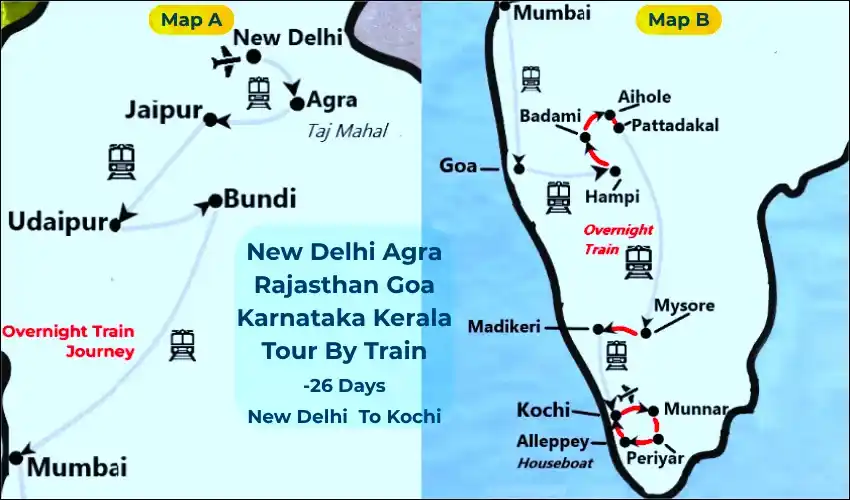
Twenty-six days start in Delhi, move through Rajasthan's forts and lakes, cross into Mumbai, then run the length of the Konkan coast into Goa, up through Karnataka's ruins and coffee hills, and finish in Kerala's backwaters, departing from Kochi.
Few itineraries attempt north and south India in a single trip with this much rail travel - three overnight trains, the Gatiman Express, the Konkan Railway's coastal run, and the regional lines that stitch Karnataka to Kerala.
This is a tour built for travellers who want India's scale to actually register, one train window at a time.
Everything you need to know about travelling India by train
Duration
26 Days, 25 Nights
Language
English
Price
US$127TOUR PRICE: From US$ 114 per person per day · Based on 2 persons ·Accommodation, breakfast, cooking classes, train fares, transport & activities included
DURATION 26 Days / 25 Nights
CITIES Delhi · Agra · Jaipur · Udaipur · Bundi · Mumbai · Goa · Hampi · Badami · Mysore · Coorg · Kochi · Munnar · Periyar · Alleppey
TRANSPORT Private AC car in all cities + Gatiman Express + Konkan Railway + regional trains + 3 overnight sleeper trains
INCLUDED MEALS Daily breakfast + 1 Rajasthani traditional dinner in Jaipur + all meals on the Alleppey houseboat
ACTIVITY LEVEL Moderate - fort and temple walking, three overnight trains, one houseboat night, one dawn Taj visit]
GROUP TYPE Private - your group only
FLIGHT INCLUDED None - fully rail and road; tour ends at Kochi for onward connections
STARTS Delhi pickup from airport or hotel
ENDS Kochi (Cochin) airport - connect to onward flight
|
Group Size |
Per Person Per Day |
Per Person Total (26 Days) |
|
2 Persons |
US$ 114 |
US$ 2971 |
|
4 Persons |
US$ 97 |
US$ 2511 |
|
6+ Persons |
US$ 89 |
US$ 2320 |
The larger your group, the better the value - bring family or friends and everyone travels for less.
Includes accommodation, daily breakfast, private AC vehicle, all train fares, all meals as per itinerary, cooking class charges and market visit fees. International flights not included. Single supplement available on request.
Day 1: Arrive Delhi
Day 2: In Old & New Delhi
Day 3: New Delhi → Agra [By Superfast Train]
Day 4: Agra → Jaipur [By Evening Train]
Day 5: In Jaipur
Day 6: Jaipur → Udaipur [By Afternoon Train]
Day 7: In Udaipur
Day 8: Udaipur → Bundi [By Evening Train]
Day 9: Bundi → Mumbai: Overnight Train Journey
Day 10: In Mumbai
Day 11: Mumbai → Goa [By Early Morning Express Train]
Day 12: In Goa
Day 13: Goa → Hampi [By Overnight Train Journey]
Day 14: Arrive Hampi
Day 15: In Hampi
Day 16: Hampi → Aihole → Pattadakal → Badami
Day 17: Badami → Mysore [By Overnight Train]
Day 18: Arrive Mysore
Day 19: Mysore → Madikeri
Day 20: In Madikeri
Day 21: Madikeri - Kochi [By Train]
Day 22: Explore Kochi
Day 23: Kochi → Munnar
Day 24: Munnar → Periyar
Day 25: Periyar - Backwaters
Day 26: Alleppey → Cochin - Depart
- Travellers with the time to see both North and South India properly on one trip, not two
- Rail enthusiasts who want India's train network as the spine of the journey, not a shortcut between it
- Couples and families comfortable with three overnight train legs (2nd AC sleeper)
- Guests who want Rajasthan's forts, Goa's coast, Karnataka's ruins and Kerala's backwaters in one continuous circuit
BEST - OCTOBER TO MARCH
Comfortable weather across all six states on this route — Delhi and Agra's winter clarity, Rajasthan's cool desert evenings, coastal Goa and Kerala at their most pleasant, and Karnataka's hills clear and dry. This is the window most guests choose for the full circuit.
SPECIAL - SEPTEMBER TO OCTOBER, MYSORE DASARA
During Dasara, Mysore Palace is fully illuminated with 97,000 bulbs every night for ten days straight, not just the usual Sunday hour. If the dates align with your travel, TTI times the Mysore stop to catch it.
PLAN AHEAD - WINTER FOG, DELHI & AGRA
December and January bring genuine fog to Delhi and Agra mornings, occasionally delaying the Gatiman Express or softening Taj Mahal visibility at dawn. TTI builds in a buffer on this leg during peak winter, given how much rail travel follows over the next three weeks.
AVOID - APRIL TO JUNE
North India's summer is intense, with Delhi, Agra and Jaipur regularly reaching 45°C, while coastal Goa and Kerala turn hot and humid at the same time. Very little of this six-state route stays comfortable in late spring. October to March is strongly preferred.

HIGHLIGHTS
- Epic 26-Day India Rail Adventure!
- Delhi to Kerala by Train: A Grand Journey.
- Taj Mahal, Rajasthan Royals & South India's Charm.
- Train Through India: Culture, Coast & Backwaters.
- North to South by Rail: A 26-Day Indian Tapestry.
- India Unveiled: Train Across Heritage & Beaches.
- Royal Rajasthan, Goa Sands & Kerala Serenity by Train.
- 26 Days, Countless Wonders: India by Rail.
- Experience India's Soul: A Train Odyssey.
- From Delhi's History to Kerala's Bliss on Rails.
Travel Itinerary
Airport → Hotel → Evening at Leisure
This 26-day India rail tour begins the way most first trips do — a traditional welcome at Delhi airport and a straightforward transfer to the hotel, no schedule pressure on arrival day. Six empires have ruled from this city, and the evidence sits layered through every neighbourhood the drive passes. Today is simply for arriving and letting the journey properly begin tomorrow.
TTI Insider : Ask for a short evening walk in Lodhi Garden before dinner - Mughal tombs sitting quietly in a city park, parakeets overhead, no ticket queue. The gentlest possible first hour in India.
Red Fort → Jama Masjid → India Gate → Humayun's Tomb → Qutub Minar
Delhi's dual identity unfolds across a single day - Old Delhi's Red Fort and Jama Masjid carry Shah Jahan's Mughal ambition, while New Delhi's wide avenues, Rashtrapati Bhawan and India Gate show what the British built on top of it. Humayun's Tomb and the Qutub Minar close the day, two UNESCO sites spanning three empires between them.
TTI Insider : At Humayun's Tomb - the building that directly inspired the Taj Mahal - walk to the rear garden instead of stopping at the entrance. The tomb rises against open sky with no one between you and it.
Gatiman Express → Taj Mahal → Agra Fort
The Gatiman Express, India's fastest train, covers Delhi to Agra in under two hours - a genuinely fast start to a day that ends at the Taj Mahal. Shah Jahan built this white marble tomb for his wife Mumtaz Mahal in the 17th century, and no photograph quite prepares a first-time visitor for standing in front of it. Agra Fort follows, red sandstone Mughal architecture just across the river.
TTI Insider: The marble genuinely shifts colour through the day - warm gold at sunrise, white at noon, soft pink toward evening. If your schedule allows any flexibility, ask about a second look at a different hour.
Leisure morning → Itmad-ud-Daulah (Baby Taj) → Evening Train To Jaipur
A free morning in Agra fits in the Itmad-ud-Daulah - the 17th-century "Baby Taj," built for Emperor Jahangir's chief minister and often called the marble draft that led to the real thing. The pace stays unhurried until the evening train to Jaipur, the Pink City, where three days of Rajasthan's royal architecture are about to begin.
TTI Insider: Ask for Deviram Sweets for breakfast before the Baby Taj - bedai, jalebi and saffron lassi that locals actually eat, not a hotel buffet. A generations-old spot most tourists never find without a guide.
Hawa Mahal → Amber Fort → City Palace → Jantar Mantar
Jaipur's Pink City earns the name in sandstone - Hawa Mahal's famous lattice facade (technically the back of the palace, built so royal women could watch the street unseen), Amber Fort's mirrored Sheesh Mahal overlooking Maota Lake, the City Palace's Mughal-Rajasthani fusion, and Jantar Mantar's astronomical instruments, still functioning after three centuries.
TTI Insider : Ask specifically for the "Magic Flower" inside Amber Fort's Sheesh Mahal — a hidden carving that reveals a fish, an elephant, a cobra and more depending on the angle. Most guides skip it unless asked by name.
Free day → Evening Train to Udaipur
Jaipur's second day is left open on purpose - shopping, a slow hotel morning, or simply more time with a city that rewards a second look. The evening train to Udaipur crosses the Aravalli Hills as the light fades, and the "City of Lakes" waits on the other side, already visible in the way the terrain has changed by check-in.
TTI Insider : Keep watch on the window as the Jaipur–Udaipur train runs at sunset. Watching lush palace gardens give way to sparse, arid Aravalli scrub explains more about Rajasthani cuisine than any menu will.
Jagdish Temple → City Palace → Evening folk dance performance
Udaipur earns its reputation on a single day - the intricately carved Jagdish Temple, then the City Palace, one of India's largest royal residences and 400 years in the building across 22 generations of Mewar rulers. Courtyards, art and views over Lake Pichola fill the afternoon before an evening Rajasthani folk dance closes the day.
TTI Insider : Pause at the eight marble Toranas just past the City Palace entrance - the scales where Maharanas once weighed themselves against gold to give away to the poor. Most guests walk straight past toward the mirror work.
Free day → Evening train to Bundi
A free day in Udaipur, with the Monsoon Palace and Saheliyon-ki-Bari Garden both worth adding on if the pace allows. Evening brings the train to Bundi - a Rajasthan town most India rail itineraries skip entirely, and one of the more rewarding decisions on this route.
TTI Insider : Skip the Monsoon Palace crowds building before sunset and ask about Bahubali Hill instead - a similar panoramic view over the lakes, with a fraction of the visitors and no queue for the jeep ride up.
Taragarh Fort → Stepwells → Overnight train to Mumbai
Bundi, tucked into the Aravalli Hills, holds Taragarh Fort above the town and some of Rajasthan's finest stepwells below it - a genuinely hidden gem, seeing a fraction of Jaipur or Udaipur's crowds. Ornate palaces and temples fill the walk before an evening train carries the group overnight, straight into Mumbai by morning.
TTI Insider : Ask what Taragarh Fort is actually built from - serpentine stone, the same mineral family as jade, genuinely shifting from pale green to deep emerald depending on the light. Most guidebooks never mention it.
Gateway of India → Towers of Silence → Prince of Wales Museum
Mumbai arrives at a different pace entirely - Bollywood's home city, seven reclaimed islands carrying more ambition per square foot than almost anywhere in India. The Gateway of India and the Towers of Silence anchor the morning, with the Prince of Wales and Gandhi Museums rounding out a day steeped in colonial and post-independence history, before Goa waits tomorrow.
TTI Insider : Ask your guide about the Tata story near Kala Ghoda - Jamsetji Tata, refused entry at a colonial-era hotel, built the Taj Mahal Hotel directly opposite. Every guest stops walking when they hear it.
Early morning Konkan Railway express → Panjim
The Konkan Railway does what no road can - it threads the Western Ghats and the Arabian Sea coastline in one continuous morning, tunnels and river bridges included. Goa arrives quietly after that: a former Portuguese colony where church bells, siesta hours and Sunday Mass still shape the week. Feni and pork vindaloo wait at dinner, both worth ordering on arrival night.
TTI Insider: Keep watch on the left-hand, sea-facing side after Panvel — the Sahyadri Ghats drop almost straight into the Arabian Sea for a good hour, one of the most dramatic stretches on the Konkan Railway.
Seat allocation is set by Indian Railways and can't be guaranteed, so it's worth simply swapping seats with a fellow traveller for that stretch to catch the view from the right side.
Fontainhas old quarter → Local Spice Estate
Panjim's old quarter, Fontainhas, still runs on Portuguese-era balconies and red-tiled roofs - Asia's last surviving Latin Quarter, and a short walk rather than a bus tour.
Afternoon shifts to a spice plantation outside the city, where pepper vines and nutmeg trees explain half of what shows up on a Goan dinner plate. Both stops sit inside the same easy day.
TTI Insider Ask for Fonte Phoenix, the small spring below Altinho Hill that gave Fontainhas its name and once supplied the whole neighbourhood's water. Most walking tours skip it entirely.
Free day → Overnight train to Hampi
A slow free day in Goa before the overnight train east - basic sleeper class, a proper Indian railway night, and Karnataka's ruined empire waiting on the other side. This is the kind of travel day that becomes a story later: the gentle rock of the carriage, the tea vendor's call at some unnamed station at 5am, Hampi's boulders rising by breakfast.
TTI Insider: Carry a light shawl even in warm months - overnight sleeper AC runs cold, and the ten-rupee platform chai the next morning is worth staying awake for.
Virupaksha Temple → Vittala Temple → Local bazaar
Hampi's boulder landscape held the wealthiest empire in South India for two centuries, and the ruins still argue the point - the Virupaksha Temple's nine-storey gopuram, and the Vittala Temple's famous stone chariot, carved from granite and pictured on India's own fifty-rupee note. An evening bazaar walk closes the day at an easier pace.
TTI Insider : Ask the caretaker to tap the musical pillars inside Vittala Temple - each one rings a different note, carved that way on purpose over 500 years ago.
Free day for photography and further exploring
A second day in Hampi, kept open on purpose. This UNESCO ruin site rewards slow mornings and long light - sunrise and sunset both turn the boulder hills a different colour, and photographers tend to build their whole day around those two windows. Hire a coracle for a Tungabhadra river crossing if the legs need a rest from walking.
TTI Insider: Go back to Vittala Temple at golden hour with fewer crowds - the stone chariot's wheels once genuinely turned before conservation fixed them in place.
Cave temples → Dravidian & Nagara temple sculpture circuit
The road from Hampi to Badami runs through sunflower fields that turn genuinely cinematic by late afternoon — the Chalukyan capital's red sandstone cliffs appearing right on cue at golden hour. Badami's 6th-century cave temples come first, then a further loop to Aihole and Pattadakal, where Dravidian and Nagara temple styles sit side by side, still studied today.
TTI Insider : Ask your guide to open the locked domed tomb by the car park — a governor's love story that almost every visitor walks straight past.
Checkout → Overnight train to Mysore
A relaxed day in Badami before the overnight train south to Mysore - basic sleeper berths, a third night of proper Indian rail travel, and the City of Palaces waiting by breakfast. Badami's own quiet detail is worth knowing before you leave: the town speaks more Marathi than Kannada, a border effect invisible on any map.
TTI Insider : Badami shuts almost completely by 8pm - plan dinner early, since the town itself is genuinely dinner-plate small once the sun goes down.
Mysore Palace → Jagmohan Palace → Evening market
Mysore Palace is reason enough for the detour - an Indo-Saracenic seat of the Wadiyar dynasty with stained glass, carved doors and a gold-plated elephant howdah inside. Jagmohan Palace follows before an evening left free for the market or a rickshaw ride through the old town. Mysore, quietly, is where this India rail tour turns royal for a day.
TTI Insider : If your visit falls on a Sunday, stay till 7pm - the Palace is lit with 97,000 bulbs for exactly one hour, and it is a different building entirely after dark.
Bylakuppe Tibetan monastery → Madikeri hill drive
The road to Madikeri detours through Bylakuppe first - the second-largest Tibetan settlement outside Tibet, gold-plated statues and monks in red robes set against Karnataka's coffee hills. It is an unexpected pairing most South India tours skip entirely, and one worth the short stop before the drive climbs into Coorg's cooler air for the night.
TTI Insider : Ask your guide why locals still call this region Kodagu, not Coorg - the British renamed it in the 1830s, but the older name goes back to 300 BCE.
Coffee plantation walk → Madikeri Fort → Raja's Seat
Coorg earns its "coffee capital of India" title on a plantation walk where you smell the estate before you see it - coffee seeds drying at doorsteps, mist still sitting on the hills. Madikeri Fort and Raja's Seat close the day with the kind of view that explains why the British built a hill retreat here in the first place.
TTI Insider: The Kodava people here may trace back to Kurdish exiles or soldiers who marched with Alexander the Great — ask your guide for both theories, nobody has settled which is true.
Drive to station → Train into Kerala
The train south into Kerala crosses a real cultural line - 44 rivers, the Western Ghats and the Arabian Sea all within a two-hour drive of each other, and God's Own Country living up to its own tourism slogan more often than not. Kochi's harbour city waits at the other end, laced with Portuguese, Dutch and Jewish history layered into one small peninsula.
TTI Insider : Keep watch on the right-hand side once the train enters the Western Ghats — the hills stay in view for most of the ride into Kerala. Seat allocation is set by Indian Railways and can't be guaranteed, so it's worth swapping with a fellow traveller for that stretch if it works out that way.
St. Francis Church → Chinese fishing nets → Kathakali performance
Fort Kochi packs five centuries of trade history into a walkable peninsula - the 16th-century St. Francis Church, the cantilevered Chinese fishing nets worked by hand at the harbour, and an evening Kathakali performance where face paint and hand gestures do the storytelling. Dinner follows at the hotel, unhurried, the way most days on this tour tend to end.
TTI Insider: Visit the Paradesi Synagogue in Jew Town - over 400 years old, and home to one of the world's oldest Jewish communities, now down to just six Paradesi families.
Drive to tea hills → Optional boating or trekking
Munnar sits at 5,200 feet, where tea plantations run in dark emerald rows over rolling hills wrapped in mist for most of the year. The Malayalam name means "land of three rivers" — a small fact your guide will mention that most guests remember for years. Boating, trekking and paragliding are all optional add-ons for guests who want the hills at a faster pace.
TTI Insider : Ask how to say "moon-aar" correctly at breakfast - it signals immediately that you are travelling with a guide who actually knows Munnar, not just its postcard views.
Cardamom Hills drive → Periyar Wildlife Sanctuary
Periyar National Park in the Cardamom Hills holds South India's best-known wildlife sanctuary - elephants, deer and birdlife moving through forest around a lake built by the British in 1895. A spice plantation walk is worth adding on if time allows; this is cardamom, pepper and cinnamon country, and the smell alone explains why colonial traders fought over it.
TTI Insider : Skip the crowded double-decker boat tour if offered - the paddle-driven bamboo raft is quieter, gets closer to the wildlife, and is guided by tribal youth trained by the Forest Department.
Drive to Alleppey → Overnight houseboat cruise
Alleppey's backwaters are Kerala's most-photographed landscape for a reason - a houseboat cruise through canals, lagoons and rice paddies earns the "Venice of the East" tag honestly. Village life along the banks continues at its own pace: washing on the water's edge, children in the shallows, kingfishers darting through the palms. Night is spent on board.
TTI Insider: Ask if a short canoe detour into the narrow backchannels is possible - houseboats cannot fit there, and it is the closest this backwaters tour gets to everyday village life.
Houseboat breakfast → Airport transfer → Tour Ends
A final breakfast aboard the houseboat closes twenty-six days that began on a Delhi airport platform and ended on a Kerala backwater - six states, three overnight trains, one dawn at the Taj, and a country that rarely felt the same twice. The transfer to Cochin airport marks the end of this India rail tour, though most guests say it doesn't feel finished.
TTI Insider : Keep a window seat for the drive to Cochin airport — the backwaters' palm-lined canals are one last good look at Kerala before the journey home.
Not sure which rail tour is right for you? Read our complete India train travel guide first.
INCLUDED
- 22 Nights’ Of Accommodation In Good Standard Hotels As Per Desire With Base Category Of Rooms At Each Place & 3 Overnight Train Journeys By 2nd Air conditiones Sleeper Class Trains
- Daily Breakfast At All The Hotels
- All Transportation, Driver And Sightseeing Tours Using An AC Medium Car.
- English Speaking Local Guide Services At All Places [Not In Goa]
- Enjoy Rickshaw Ride On Silver Street Chandni Chowk, Old Delhi
- Rajasthan Village Theme Visit & Rajasthan Traditional Veg Dinner
- Folk Dance Show in Udaipur
- All Train Fares As Per Tour Plan
- Cruise Kerala's backwaters on a houseboat
- All Pick-Ups & Drop-Offs As Per Itinerary.
- All Taxes, Parking, Toll Charges, Driver Allowance, And Service Charges
EXCLUDED
- Medical Insurance Of Any Kind
- Any Domestic / International Flight Fares
- Any Meals ( Unless Specified ) Anything Except In Inclusions
- Any Monument Fees As Per Tour Plan
- Any Expenses Arising Out Of Unforeseen Circumstances Like Flight Delay/Cancellation/Fare Hike, Strike Or Any Other Natural Calamities.
- Personal Nature Expenses I.E. Telephone Calls, Laundry, Soft / Hard Drinks, Meals, And Tipping
Frequently Asked Questions
Yes there is a supplement for solo traveler. You can check the price with us for the same.
Mostly all the hotels are giving free WI-FI in the tour.
Yes, All Airport / Railway Transfers Are Included In The Tour Plan
As you will be exploring places of India, hence Indian Rupees shall be required to pay in local areas In hotels and restaurants
In Travel Industry We Are Working Since 2013.
You Shall Receive Whole Tour Kit Which Includes Hotel Vouchers, Train / Flight Tickets / Meals Vouchers As Per Tour Plan.
Tour Terms & Conditions
- Until 90 days prior to arrival – 30% of the deposited amount
- Between 89 days to 60 days prior to arrival – 40% of the deposited amount
- Between 59 days to 0 days prior to arrival – NO REFUND
For more details, read our Terms and Conditions
HAVE A QUESTION IN MIND
Looking for more info? Send a question to the tour agent to find out more.

RECOMMENDED HOTELS
![Mumbai Goa Karnataka Kerala Tamil Nadu Tour By Train [25 Days]](https://d2hftrqi7e9gf8.cloudfront.net/packageimages/f7ea11af-99b5-43b5-933a-3a6cabbeb527.jpg)
Mumbai Goa Karnataka Kerala Tamil Nadu Tour By Train [25 Days]
India Train Tours
Click For More Reviews On


New Delhi To Rajasthan With Mumbai By Rail [11 Days]
India Train Tours
Click For More Reviews On