India by Train — The Only Way to See All of It
TTI Tours / 28/08/2026
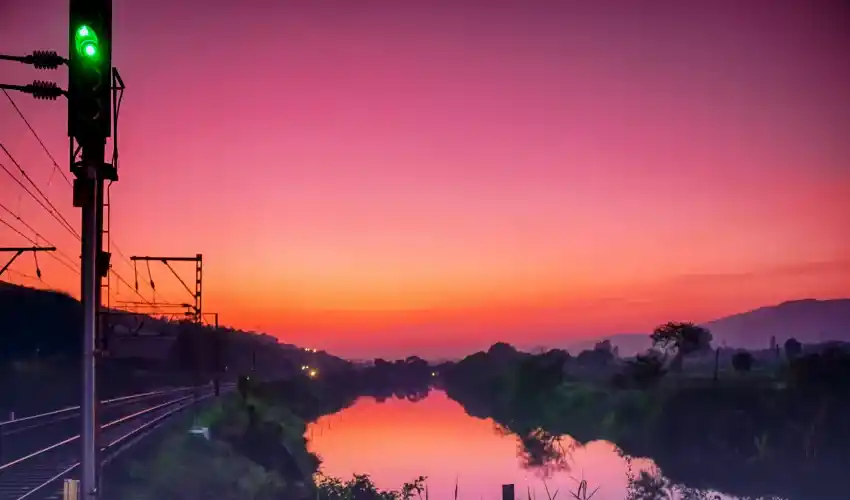
India by Train —
The Only Way to See All of It
No Flight Shows You India.
No Car Does Either. Only the Train Does.
We have been running private guided tours across India since 1999. In that time, we have put thousands of international travellers on planes, in cars, on boats and on rickshaws. But when people ask us — genuinely ask us, not as a formality — what is the single best way to experience this country, the answer is always the same. Take the train.
India's railway network covers 67,000 kilometres. It connects fishing villages on the Keralan coast to desert forts in Rajasthan, tea estates in the Nilgiri hills to the ghats of Varanasi, the Himalayan foothills to the southernmost tip of the subcontinent. No airline route shows you any of that. You board, you cruise above the clouds, you land somewhere that looks different but feels disconnected. The train gives you the journey itself — and in India, the journey between places is half the experience.
That said, India's trains have changed dramatically in recent years. The new Vande Bharat Express has genuinely transformed what rail travel feels like on this subcontinent. More on that shortly. But first — the routes. Because the question is not whether to travel India by train. The question is which journey to start with.
We have put together a complete guide to India's greatest rail journeys — the classic long-distance routes, the UNESCO heritage mountain railways, the new semi-high-speed Vande Bharat trains, and the private guided rail tours we operate for international visitors. If you have ever thought about seeing India by train, this is where to start.
The UNESCO Heritage Mountain Railways
Three historic railways that have been running for over a century — and remain the most romantic train journeys in Asia
Before we get to the long-distance tours, a word about India's three UNESCO World Heritage mountain railways. These are not just transport — they are the journeys themselves. Narrow-gauge steam-era locomotives, altitude climbs through mist and tea gardens, tunnels blasted through the Himalayas in the 1890s. Every serious India itinerary should include at least one of them.
India's Rail Revolution for International Travellers
If you last read about Indian trains five years ago, things have changed significantly. The Vande Bharat Express is India's new semi-high-speed train — and it has genuinely transformed what rail travel feels like on this subcontinent. When we tell international clients arriving from Europe or Australia that India now has modern, air-conditioned, Wi-Fi equipped trains running at 130–160 km/h, some of them still look surprised. They should not be.
The onboard experience — airline-style rotatable seats, large windows, on-board catering, Wi-Fi, electric outlets, infotainment systems — is a genuine step change from the classic Indian railway carriage. Delhi to Jaipur now takes 3.5 to 4 hours. Mumbai to Goa runs the Konkan coastline in 7 to 8 hours. Delhi to Varanasi in about 8 hours. These are the exact corridors that our rail tours use.
And in 2026, Indian Railways has launched the Vande Bharat Sleeper Express — covering over 1,100 km overnight at speeds that make it one of the fastest sleeper trains in the country. For international travellers who have been hesitant about overnight trains in India, the Sleeper Express changes the conversation completely. Where relevant, our private guided tours incorporate Vande Bharat services to give clients the best possible onboard experience between destinations.
Our Private Guided India Rail Tours
Seven fully private rail journeys — each designed to show you a different face of India by train, with your own guide and vehicle throughout
Every tour below is fully private — your own guide, your own vehicle where needed, your own pace. We do not operate group departures. When you board a train on one of these tours, you have already been briefed, your berths are confirmed and someone who knows India deeply is travelling with you. That is what makes the difference between a stressful train experience and the best journey of your life.
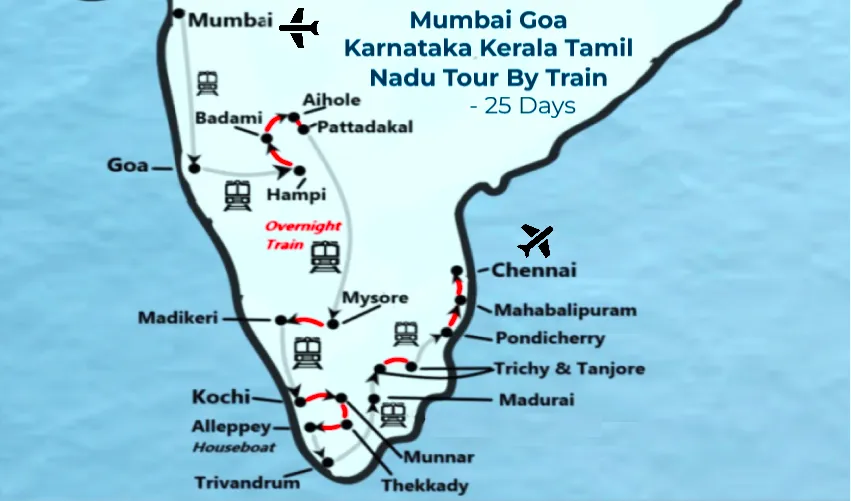
This is the grand one — the full western and southern sweep of India by rail. You start in Mumbai, one of the world's great cities, and the train takes you south along the Konkan coast to Goa, Karnataka's temple towns, the backwaters and spice hills of Kerala, and finally Tamil Nadu — Madurai's Meenakshi Temple, the Nilgiri Mountain Railway, Kanyakumari at the tip of the subcontinent. Twenty-five days of India changing outside your window, every single day different from the last.
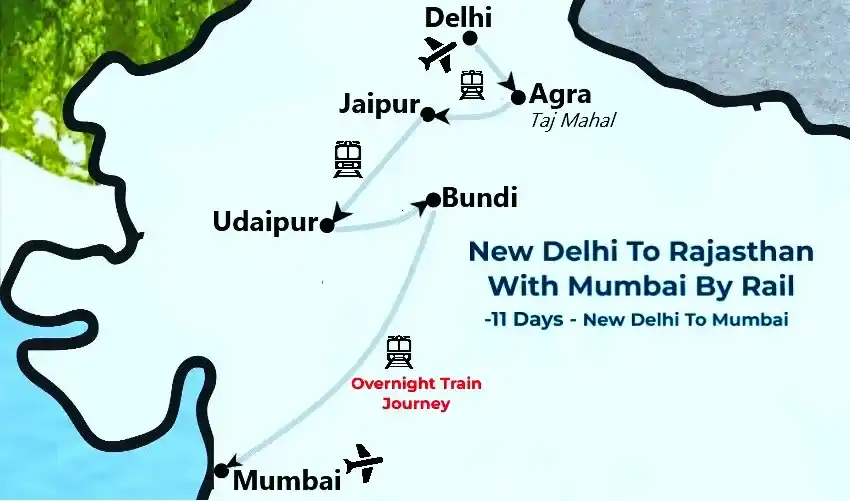
For those with limited time who want the essential India — this eleven-day tour is the one we most often recommend to first-time visitors. Delhi's Mughal monuments, the royal cities of Rajasthan — Jaipur, Jodhpur, Udaipur — all connected by train, finishing in Mumbai with its colonial architecture and extraordinary energy. Short enough to do on a generous two-week trip. Deep enough to feel real.
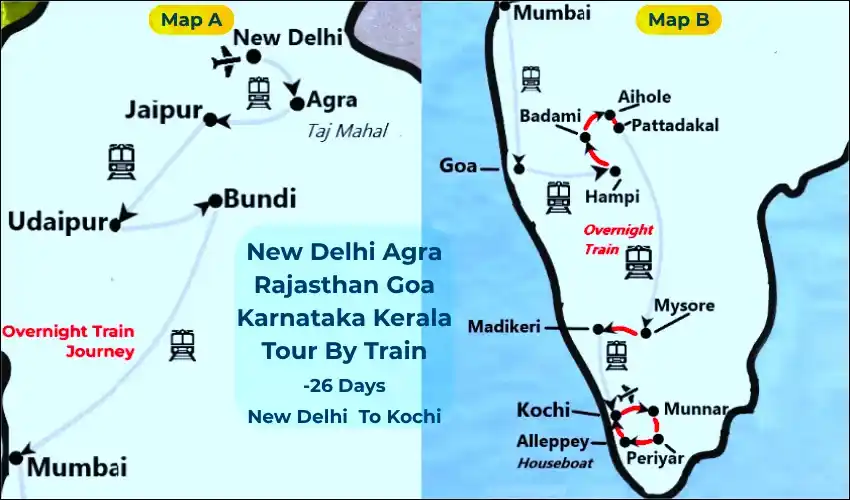
The most comprehensive rail journey we operate — twenty-six days covering the full spine of India from the Taj Mahal in the north to the backwaters of Kerala in the south. This is the tour for travellers who want to come back and say they have genuinely seen India. The Taj at sunrise, Rajasthan's desert forts, Goa's Portuguese coastline, the spice gardens of Karnataka, the Keralan backwaters by houseboat — all connected by one extraordinary rail journey.
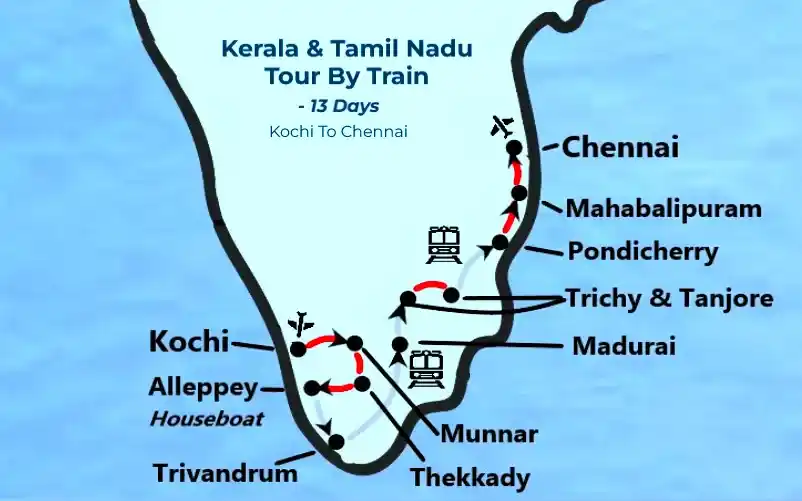
South India is a completely different country from the north — different language, different food, different architecture, different rhythm. This thirteen-day tour explores two of its greatest states by rail. Kerala: the backwaters, the hill stations of Munnar, Fort Kochi's spice-trade history. Tamil Nadu: the Nilgiri Mountain Railway, the extraordinary temple complexes of Madurai and Thanjavur, the beaches of Mahabalipuram. A deeply satisfying journey for those who want depth over distance.
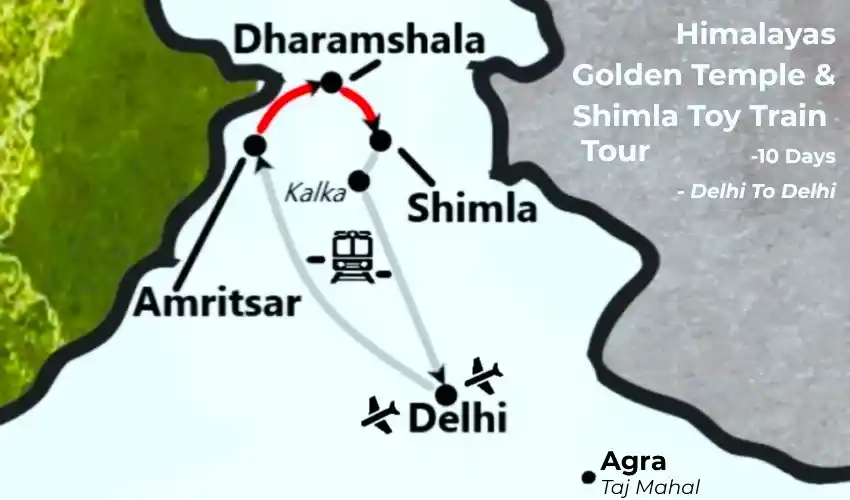
This ten-day journey heads north — to the Sikh heartland of Punjab, the Golden Temple at Amritsar (one of the most moving places in India, regardless of your faith), and then up into the Himalayan foothills on the UNESCO Kalka-Shimla Railway. One hundred and two tunnels. Eight hundred and sixty-four bridges. Pine forests opening into mountain panoramas. Shimla was the summer capital of British India, and the colonial architecture and Himalayan air together create something quite unlike anywhere else on the subcontinent.
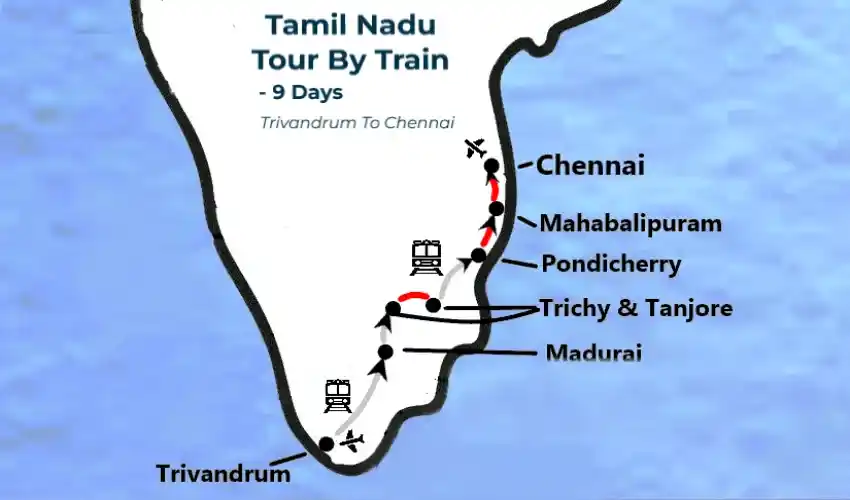
Tamil Nadu is one of the oldest living civilisations on earth — and its temple towns, coastal towns and hill stations are genuinely unlike anything in the rest of India. This nine-day focused tour explores the state by rail: Chennai, Mahabalipuram's ancient shore temples, Thanjavur's Brihadeeswarar Temple, Madurai's Meenakshi Amman, the Nilgiri Mountain Railway up to Ooty. Nine days that feel like a complete and deeply satisfying journey in themselves.
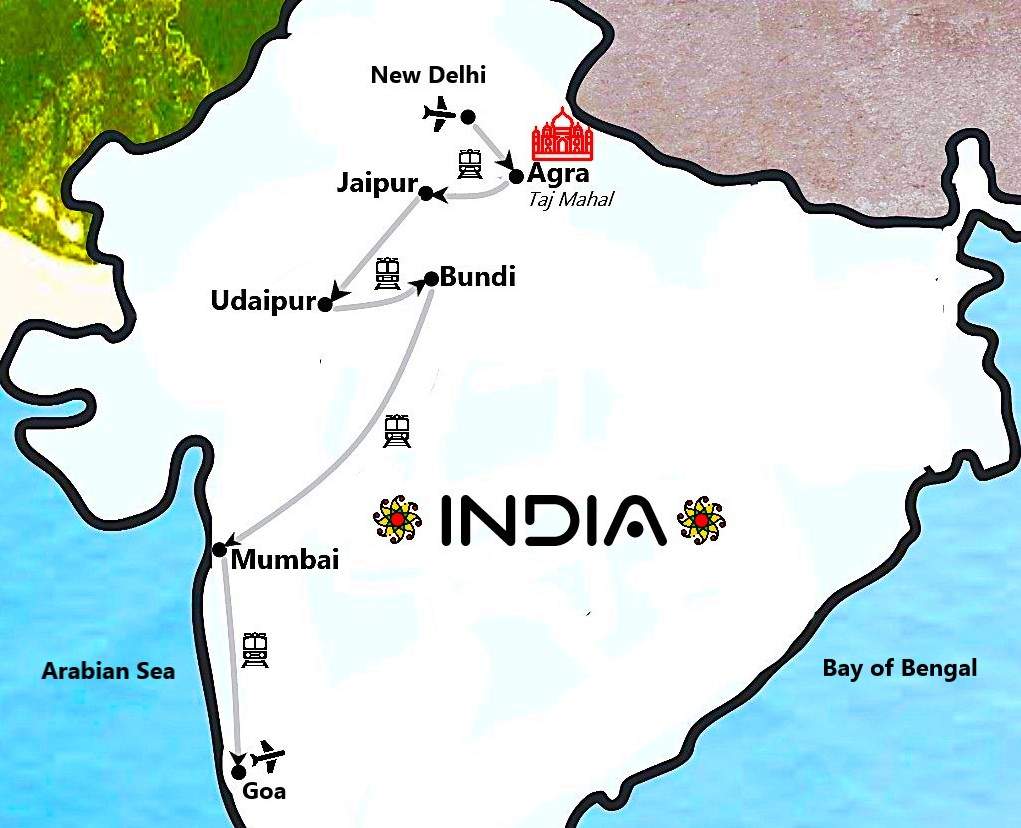
This fourteen-day tour is the one clients book when they want history, desert and the beach in one journey. Delhi, the Taj Mahal, the royal cities of Rajasthan — and then the train west to Goa, where the pace drops completely, the architecture turns Portuguese, the seafood is extraordinary and the Arabian Sea is right there. A genuinely satisfying combination that gives you three very different faces of India across two weeks.
Before You Board — What You Need to Know
The practical details that make the difference between a stressful rail journey and an extraordinary one
Indian Railways is the fourth largest rail network in the world. Navigating it independently as a foreign visitor — booking the right class, the right train, the right berth, understanding reservations and quotas and waitlists — is genuinely complex. This is one of the main reasons our clients choose to travel with a guide rather than independently. We handle every rail booking, every transfer, every connection. You focus on what you came for.
🚂 Train Classes — Which to Book
Always request a window seat when you contact us about your tour. On every Indian train journey we book, we specify window allocation at the time of reservation. The view from an Indian train window — whether it is the Thar Desert at sunset, the Konkan coast with the Arabian Sea appearing and disappearing between rocks, or the Nilgiri tea gardens in morning mist — is part of the experience. Do not sit in the aisle and miss it.
When to Travel — Best Time for India Rail Holidays
October to March is the best overall window for India train travel. The weather is cooler and clearer across the north, Rajasthan and the Deccan plateau — the views from train windows are at their most vivid, mornings are comfortable and the light for photography is exceptional. This is peak season; book early, especially for overnight berths.
July to September — the monsoon — turns India dramatically green. The Konkan coast journey to Goa in the rain is genuinely spectacular: waterfalls appear from nowhere along the cliff faces, rivers run full and brown, the jungle presses right to the tracks. South India's trains run well in the monsoon and the landscape is extraordinary. Some routes in the north and Himalayas can be disrupted by landslides — we advise on this when planning your tour.
April to June is hot across the plains — very hot in Rajasthan — but manageable with proper planning. Trains run normally, monuments are less crowded, and prices for accommodation are lower. The Himalayan routes are excellent in April and May before the monsoon arrives.
Indian Railways opens reservations 120 days in advance. For travel in October, November and December — the most popular months — berths on key routes like Delhi-Jaipur, Mumbai-Goa and overnight trains to Kerala fill within days of opening. If you are planning a train tour of India for peak season, contact us at least 4–5 months ahead. We hold allocations on major routes specifically for our private guided clients.
- Let TTI handle all bookings — navigating IRCTC's reservation system as a foreign visitor is unnecessarily complex. We manage every berth, every connection, every waitlist clearance as part of your tour.
- Pack light for train journeys — overhead racks and under-berth storage are generous but a suitcase on wheels becomes difficult on crowded platforms. A good-sized backpack or soft-sided bag is ideal.
- Embrace the platform culture — at every major station, chai vendors, samosa sellers and fresh lime soda stalls appear at the window. This is part of the journey. Budget five minutes at each stop to buy something.
- Vande Bharat has charging points — every seat has a power socket. Bring your adapter for Indian sockets (Type C, D and M) and keep devices charged between destinations.
- Overnight trains are an experience — not an endurance test. In 1A or 2A class with bedding provided, an overnight train journey in India is comfortable, safe and genuinely one of the more memorable nights of any India trip.
- Photography is permitted on trains — but not in stations or of railway infrastructure, which is classified as a security sensitive area. On the train itself and from the windows, shoot freely.
Trusted by travellers worldwide since 1999
⭐⭐⭐⭐⭐ Rated Excellent · TTI Tours India
🟢 Read Our Reviews on TripAdvisor →Ready to See India by Train?
Tell us where you want to go, how long you have and what matters most to you — and we will build you a private rail journey that fits. No group tours. No compromises. Just India, by train, the right way.
💬 WhatsApp Us — Free Quote in 1 HourBlogs Frequently Asked Questions
Related Travel Guides

Recent Comments
Just wrapped up the most incredible Luxury Golden Triangle Tour in India! Every detail was flawlessly managed, from opulent stays to seamless experiences. Huge thanks to Ashu, our amazing travel agent, for making it truly unforgettable. Highly recommend for a premium journey!
Subcategories
Famous India Tours
Festivals In India

Leave a Comment